
Northern Virginia is the largest data center market on earth, West Virginia just rewrote its laws to compete for the overflow, and the ground under both is a lattice of recorded rights that decides what every site is actually worth. This is my regional guide to acquiring data center property across Virginia and West Virginia: where the deals are, what buyers run into, and how the closing gets done clean.
Written by Anthony I. Shin, Esq., Principal and real estate attorney at Prime Title & Escrow
On a data center, the recorded rights are the asset. The building is what sits on top of them.
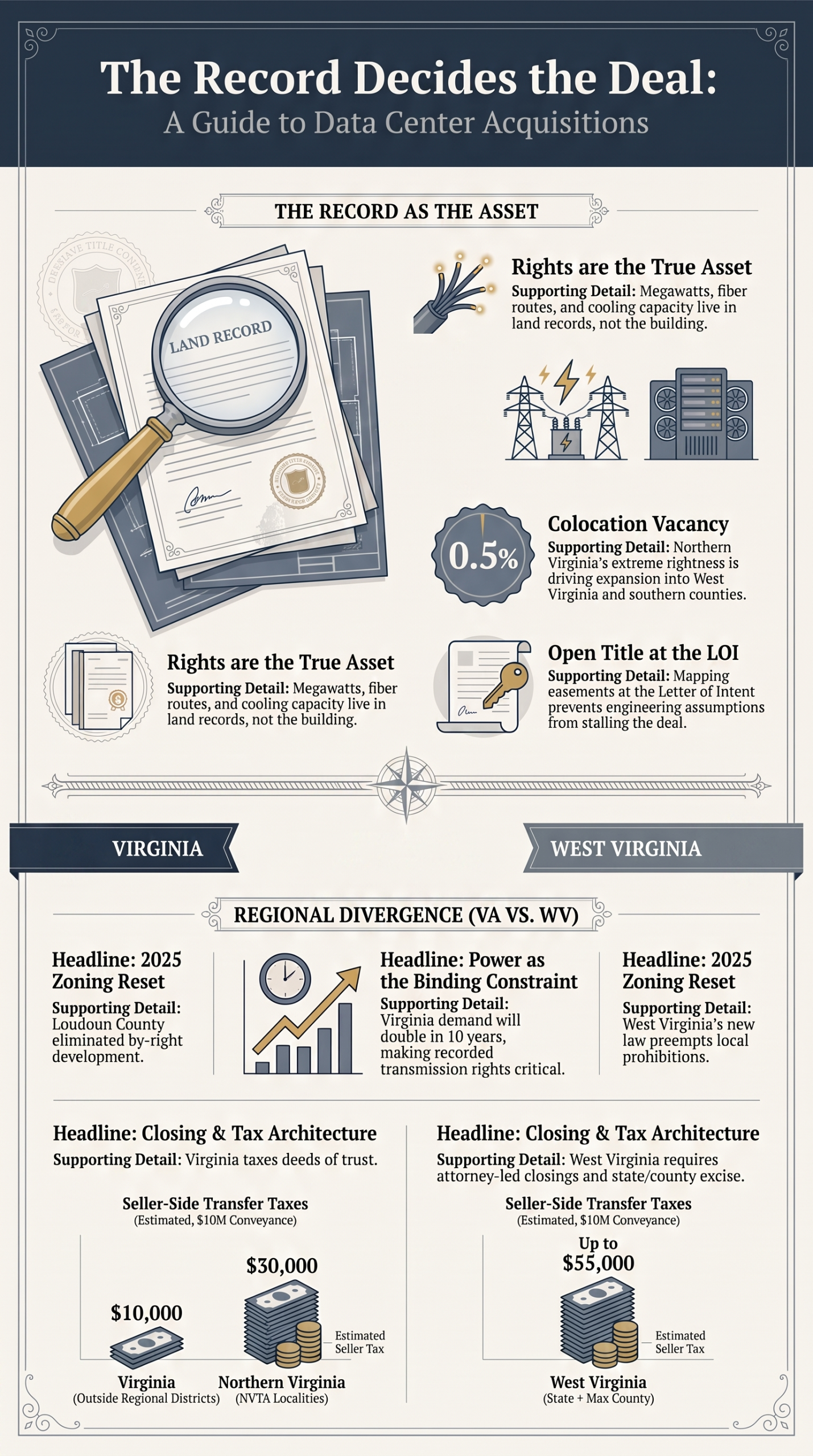
Northern Virginia holds 13 percent of reported global operational data center capacity, colocation vacancy sits at 0.5 percent, and the Joint Legislative Audit and Review Commission projects that unconstrained power demand in Virginia would double within ten years. Loudoun County eliminated by-right data center development in March 2025, and West Virginia answered with the Power Generation and Consumption Act, a 2025 law built to pull the next wave of projects across the border.
Every one of those forces lands on the buyer through the county land records: power and fiber easements, legal access, proffers, expansion parcels, liens, and two very different transfer tax systems. This guide walks through all of it, region by region and issue by issue. Every figure is attributed to its source, with the full list at the end.
I put this guide together because data center acquisitions are where everything I do converges: complicated land, layered rights, institutional money, hard deadlines, and closings where a single missed document can cost months. My aim is not to predict the market or to sell you on a region. It is to show you, plainly, what buyers and their teams run into across Virginia and West Virginia, and what a careful, independent closing does about each item. Where the data does not tell us something, I say so rather than guess.
Watch the overview: what data center buyers run into across Virginia and West Virginia, and how the closing gets done clean.
On a data center, the rights are the asset
A data center site is priced on what it can deliver: megawatts, fiber routes, cooling capacity, and room to grow. Yet almost none of that lives in the building. It lives in the county land records, in the form of transmission and utility easements, conduit rights, access easements, recorded proffers, restrictive covenants, and the legal descriptions that define exactly which parcels convey. A shell without power rights is a warehouse. Ground without legal access is a view.
That is why my thesis for every data center buyer is the same whether the site is in Ashburn or the Eastern Panhandle of West Virginia: the record decides the deal, so read the record first. The buyer who pulls the full recorded picture at the letter of intent negotiates from facts. The buyer who waits for closing week inherits whatever the record says, on the seller’s schedule. Everything else in this guide is a variation on that theme, and it is the same approach I built into my dedicated data center acquisition service page.
The market you are walking into, by the numbers
Start with scale. The Joint Legislative Audit and Review Commission, the Virginia General Assembly’s research arm, found that Northern Virginia is the largest data center market in the world, holding 13 percent of reported global operational capacity and 25 percent of capacity in the Americas. JLARC counted roughly 340 data center buildings in the Commonwealth drawing about 5 gigawatts of power, and estimated the industry contributes 74,000 jobs, $5.5 billion in labor income, and $9.1 billion in GDP to Virginia annually, most of it from the construction phase.
Now the tightness. CBRE reported Northern Virginia colocation vacancy of just 0.5 percent in the second half of 2025, with much of the coming year’s capacity already committed. That number has been falling for years, and it is the single best explanation for why buyers are pushing outward into new Virginia counties and across the state line.
And the constraint. An independent forecast commissioned by JLARC found that unconstrained demand for power in Virginia would double within the next ten years, with the data center industry as the main driver, and concluded that building enough generation and transmission to meet that demand will be very difficult. When the referee of Virginia’s own legislature says the grid is the binding constraint, every buyer should read power rights as the first diligence item, not the last.
The regional map: where the deals actually are
Data Center Alley is the anchor. Eastern Loudoun County, centered on Ashburn and Sterling and running toward Leesburg, Arcola, and Dulles, carries the densest concentration of computing capacity anywhere. County staff calculated roughly 46 million square feet of data centers built or holding a building permit as of early 2025, with about 61.5 million square feet of additional potential development on the books, and county officials have put the industry’s share of Loudoun’s general fund revenue at 38 percent.
The rest of Northern Virginia follows the fiber and the substations. Prince William County has grown into the second great concentration, from the Manassas and Manassas Park corridor to Gainesville and Bristow, with the PW Digital Gateway corridor along Pageland Lane keeping land use debate on the front page. Fairfax County carries major campuses around Chantilly, Herndon, and Reston, while Arlington, Alexandria, Falls Church, and the City of Fairfax sit on the interconnection heritage that started it all.
The western and southern edges are the growth story. Fauquier County around Warrenton, Culpeper, Stafford, Spotsylvania, Caroline, King George, and the Frederick County corridor around Winchester are all fielding projects that once would have gone to Ashburn. In Central Virginia, Henrico County anchors the Richmond market at the White Oak Technology Park near Sandston, with Hanover, Chesterfield, Goochland, and Louisa drawing campuses of their own. Southside Virginia has Microsoft’s long-running Boydton campus in Mecklenburg County and sites moving in Pittsylvania and Halifax, Southwest Virginia offers hardened sites in Wise County, and Hampton Roads brings something no inland county can: the transatlantic subsea cables that land at Virginia Beach, with Norfolk, Chesapeake, and Suffolk nearby.
West Virginia is the new chapter. The Eastern Panhandle counties of Berkeley, Jefferson, and Morgan, anchored by Martinsburg, Charles Town, and Ranson, sit within the same fiber and workforce orbit as Northern Virginia at a fraction of the land cost. And since 2025, the state has an aggressive statutory framework for projects that bring their own power, with early microgrid proposals surfacing in counties like Tucker, Mingo, and Mason. I cover the law itself in the zoning chapter and the closing mechanics in the West Virginia chapter, because both differ sharply from Virginia practice.
Power: the constraint that reprices everything
JLARC’s energy modeling is blunt: meeting even half of unconstrained demand would require building generation and transmission at a pace Virginia has rarely sustained. For a buyer, that macro constraint becomes very local, very fast. The questions that decide a site are whether power can be delivered to this parcel, on what timeline, across whose land, and under what recorded rights.
The record answers more of that than most buyers expect. Transmission and distribution easements show where the utility may build and what it may cross. Substation parcels and the rights serving them show up in the chain of title. Easements benefiting or burdening neighboring land can decide whether a new feed is even possible without another negotiation. None of that replaces the utility’s own interconnection process, and I never pretend it does. Capacity, queue position, and delivery dates belong to your engineers and the utility. What the record grants, where it runs, and whether it actually reaches your parcel is title work, and it is exactly the review I run early so the engineering conversation starts from documents rather than assumptions.
One more power wrinkle is unique to West Virginia: under the 2025 Power Generation and Consumption Act, qualifying projects can generate their own power inside certified microgrid districts rather than drawing from the regional grid. That changes the diligence file. Instead of one utility relationship, the buyer may be acquiring generation assets, fuel supply arrangements, and the land rights under all of it, and every one of those layers has a recorded footprint to verify.
Fiber and connectivity: the rights you cannot see
Fiber is buried, which means it is easy to take on faith and expensive to assume. The physical strands crossing a site typically live inside recorded conduit and telecommunications easements, and the questions that matter are the same every time: what was granted, to whom, where does it run, is it exclusive, and does it actually reach this parcel or merely pass nearby. A route that dead-ends one parcel short of yours is a negotiation, not an amenity.
Geography sets the ceiling. Ashburn’s density exists because the fiber does, Prince William and Fairfax ride the same trunks, and Virginia Beach matters because transatlantic cables come ashore there. In the newer counties, and especially across the state line in the Eastern Panhandle, the recorded fiber picture is thinner and the diligence has to be sharper. On every data center file I open, the recorded easement set for power, fiber, and access is pulled at the letter of intent and put in front of the buyer’s network engineers and counsel side by side, so the record and the engineering diligence check each other.
Land, legal access, and expansion ground
Data center deals are land deals wearing a technology story. Campuses are assembled from multiple parcels, expansion phases are priced into the deal years before they are built, and the legal descriptions carry all of it. My rule on assemblages is simple: tie the legal description to the survey and the contract, parcel by parcel, before signing. If a phase you priced is missing from the deed, or an outparcel is misdescribed, you want to hear it from your title team early, not from the surveyor after closing.
Legal access deserves its own paragraph because it fails quietly. The driveway everyone has always used is not the same thing as a recorded right of access, and on rural sites in Fauquier, Caroline, Southside Virginia, or the Panhandle, the difference can be the whole deal. The same is true of haul roads and construction access during the build. I confirm access from the record at the letter of intent, and if it needs curing, that work starts immediately rather than inside the closing window.
Two more land items surface constantly on Virginia sites. First, rollback taxes: land taxed under use-value assessment can trigger rollback taxes reaching back up to five years plus the current year, with interest, under Virginia Code 58.1-3237 when the use changes, and who pays is a contract term rather than a default. Second, severed rights: mineral and timber estates sold or reserved generations ago still bind the ground, particularly in Southside, Southwest Virginia, and much of West Virginia, and the buyer’s title work will find them whether or not anyone mentions them. Both items belong in the price conversation, not the closing week conversation. If raw ground is the deal, my commercial land guide goes deeper on all of this.
Zoning and proffers: the 2025 reset
The rules changed in 2025, in opposite directions on each side of the state line. On March 18, 2025, the Loudoun County Board of Supervisors approved comprehensive plan and zoning ordinance amendments that eliminated by-right data center development countywide. New projects now require a special exception, with public hearings before the Planning Commission and the Board of Supervisors, in districts where administrative approval used to be enough. A grandfathering resolution protects applications accepted before February 12, 2025, but only for projects more than 500 feet from residential areas that are diligently pursued without substantial modification. And the county is not done: Phase 2 of the effort, approved in September 2025, is drafting use-specific standards for data centers and substations right now, with text amendments under development into 2026.
West Virginia went the other way. House Bill 2014, the Power Generation and Consumption Act, was signed in April 2025 and took effect that July. It creates certified microgrid districts and a High Impact Data Center designation for projects with 90 megawatts or more of critical IT load, streamlines state certification, sets a special property tax valuation and distribution formula, and, most striking of all, prohibits counties and municipalities from enforcing ordinances that would prohibit or hinder certified projects. Certification rules took effect in late December 2025, and the state received its first application in mid 2026.
For a buyer, the practical lesson is the same in both states: the entitlement picture is moving under the deal, so date-stamp everything. In Virginia, confirm exactly which regime the site sits under, whether a grandfathering position exists, and what recorded proffers from past rezonings run with the land, because proffers bind the new owner regardless of what the seller remembers. In West Virginia, confirm whether the project is inside or pursuing a certified district, because that single fact determines whether local zoning applies at all. Zoning strategy belongs to your land use counsel. Surfacing every recorded proffer, condition, and covenant early enough for that strategy to work belongs to me.
Water, environment, and the community file
JLARC found that data center water use in Virginia is currently sustainable but growing, and that localities have increasingly focused on noise, siting, and compatibility near neighborhoods. That policy backdrop shows up in deals as recorded instruments: utility and water line easements, stormwater facility agreements, conservation easements that sterilize part of a parcel, and conditions attached to past approvals. In West Virginia, early microgrid proposals have drawn organized community concern over air, water, and local control, which means permits and public records deserve the same early attention as title.
I stay in my lane here. Environmental assessment, wetlands, and permitting belong to your consultants and counsel. What I bring is the recorded layer: every easement, covenant, and condition that touches the ground, pulled early and put in front of the right specialist, so nothing in the record ambushes the environmental work later.
The title issues that actually surface
The American Land Title Association’s 2026 study of title production found that more than 80 percent of purchase transactions require review of at least 11 documents, that 21 percent involve more than 50 records, and that nearly 60 percent require clearing three to five title issues before closing. Those are averages across all purchases. Data center sites sit at the heavy end of every one of those distributions, because industrial land carries decades of financing, construction, and utility activity on its back.
On data center files specifically, the recurring exceptions are old deeds of trust and financing statements that were paid but never released, mechanic’s liens from years of construction and fit-out work, utility easements that no longer match what is on the ground, boundary and legal description conflicts on assembled parcels, and covenants or proffers from a prior owner’s era that quietly restrict the current plan. Virginia adds a sharpened edge: the mechanic’s lien framework in Title 43 of the Code of Virginia gives properly perfected liens from recent work a reach that can surprise buyers who assumed a clean cutoff at closing. None of these items is exotic, and nearly all of them are curable, but only on a calendar that starts early. That is the entire argument for opening title at the letter of intent, and it is why an owner’s policy matters at this scale; I explain the coverage itself in what title insurance is.
The Virginia closing: recordation taxes and regional fees
Virginia’s transfer costs stack in layers, and on data center numbers the layers matter. The buyer pays the state recordation tax on the deed at $0.25 per $100 of value under Virginia Code 58.1-801, plus a local recordation tax of up to one third of the state tax under 58.1-814, roughly $0.083 per $100 in most localities. The seller pays the grantor’s tax at $0.50 per $500 under 58.1-802. On a financed deal, the deed of trust carries its own recordation tax under 58.1-803, at $0.25 per $100 on the first $10,000,000 of the obligation with tiered rates stepping down above that.
Northern Virginia adds two regional charges that surprise out-of-market sellers. In every Northern Virginia Transportation Authority member jurisdiction, which includes Loudoun, Fairfax, Prince William, Arlington, Alexandria, Falls Church, Fairfax City, Manassas, and Manassas Park, the grantor also pays the regional WMATA capital fee at $0.10 per $100 under 58.1-802.3 and the regional congestion relief fee at another $0.10 per $100 under 58.1-802.4. Hampton Roads jurisdictions carry their own regional fee at $0.06 per $100 under 58.1-802.5 instead. On a $10,000,000 conveyance, the buyer’s deed side runs about $25,000 state plus roughly $8,300 local, and the seller’s side runs $10,000 statewide, or $30,000 inside Northern Virginia once the two regional fees are added.
The West Virginia closing: a different structure
Cross the state line and the tax architecture changes shape. West Virginia imposes a transfer excise tax under West Virginia Code 11-22-2: a state tax of $1.10 per $500 of value plus a county tax of at least $0.55 per $500, which counties may raise as high as $1.65 per $500, all generally paid by the grantor, plus a flat $20 fee that funds affordable housing. There is no Virginia-style recordation tax on the deed of trust amount, which meaningfully changes the math on debt-financed acquisitions. On the same $10,000,000 conveyance, the grantor’s excise runs $22,000 to the state and $11,000 to $33,000 to the county depending on the local rate, for a combined $33,000 to $55,000.
Two more West Virginia practice points matter. First, West Virginia is an attorney closing state, so a licensed West Virginia attorney conducts the closing, and we build that into the file from day one rather than discovering it at the table. Second, for projects pursuing High Impact Data Center status under the 2025 law, the property tax treatment itself changes: certified projects file with the Board of Public Works rather than being assessed by the county, with collections distributed by statutory formula, half of it to a state personal income tax reduction fund and 30 percent to the host county. Underwriting a West Virginia site without modeling that framework means underwriting the wrong numbers.
Entities, joint ventures, and authority
Almost no data center trades between two individuals. The buyer is a special purpose entity under a fund, a joint venture between an operator and capital, or a platform making its tenth acquisition this year. The seller is often just as layered. That is normal, and it is also where closings quietly stall, because every entity in the chain needs formation documents, good standing, resolutions, and confirmed signing authority before anyone reaches the table, and out-of-state structures add registration questions on top.
My practice is to collect and verify the authority file at contract, not at closing, on both sides of the transaction. When the deal is part of a larger corporate transaction, a divestiture, a platform sale, or a recapitalization, the real estate closing also has to land on the corporate closing date, with deeds, assignments, consents, and debt releases sequenced to the deal calendar. That coordination with deal counsel is a core part of what an independent settlement team does, and it is the same discipline whether the closing funds through a 1031 exchange, a fund waterfall, or a corporate treasury.
Escrow and funds at data center scale
The most preventable catastrophe in any closing is a redirected wire, and the exposure scales with the deal. The Federal Bureau of Investigation has warned for years that business email compromise schemes specifically target real estate transactions, watching the file and striking with fraudulent payment instructions at the exact moment money is about to move. At data center prices, a single successful redirect is not a bad day. It is a company-altering loss.
So the funds discipline is absolute. Wiring instructions are established at the start of the file and verified by phone with known contacts, every change to payment instructions is treated as fraud until proven otherwise, funds move only when the recorded conditions are met, and every disbursement is documented. I have written a plain-English breakdown of how real estate wire fraud works and how to send closing funds safely, and both apply at $10,000,000 exactly as they do at $500,000, just with more zeros at stake.
Challenges, and how we clear them
These are the six issues I see most often on data center acquisitions across both states, in the same format I use on my service pages: the challenge as the buyer experiences it, and what my team actually does about it.
1. Power and transmission easements that do not match the plan. The site needs a new feed, and the recorded rights were written for a different era. How we clear it: we pull the full recorded easement set at the letter of intent, map what was actually granted, and put it in front of your engineers and counsel before the diligence clock burns.
2. Fiber and conduit rights that stop short. The marketing package says connected, and the record says the easement ends one parcel away. How we clear it: we verify each telecommunications easement against the survey, so a missing link becomes a negotiating item instead of a post-closing surprise.
3. Legal access and haul roads. The site fronts a private road, or construction access crosses a neighbor. How we clear it: we confirm access of record at the letter of intent, and if it needs curing, we start the curative work immediately.
4. County rules changing mid-deal. Loudoun rewrote its ordinance in March 2025 and is drafting Phase 2 standards now, other localities are following, and West Virginia preempts local rules only inside certified districts. How we clear it: we date-stamp the entitlement facts, surface every recorded proffer and condition, and keep your land use counsel working from the same documents we are.
5. Expansion parcels that do not transfer. The phase you priced is missing from the legal description. How we clear it: we tie the legal description to the survey and the contract, parcel by parcel, before you sign.
6. Liens from years of construction. Old deeds of trust, financing statements, and mechanic’s liens sit on the record long after they were satisfied. How we clear it: we chase the releases and curative documents early, so the commitment comes back clean while there is still calendar left.
The pre-letter-of-intent diligence list
Here is what I ask serious data center buyers to assemble before or at the letter of intent, because every item shortens the closing: the contract or letter of intent and any option or phasing schedule; the full parcel list with tax identification numbers; any existing survey and prior title policy; the entity chart with formation documents and signing authority on your side; your lender’s contact and term sheet if the deal is financed; the seller’s known easement and lease files, including any operator or colocation agreements; and your engineering team’s power and fiber contacts, so the record review and the technical review run in parallel rather than in sequence.
None of that is busywork. Each item maps to a failure mode in this guide, and a buyer who shows up with the file assembled routinely saves weeks. If you want the deeper version of what sits behind each item, my page on what a title and escrow company does walks through the machinery.
How the closing runs, open to record
Every data center file I run follows the same spine. We open title and escrow at the letter of intent and order the search across every parcel. The commitment comes back and we walk the exception list with your counsel, splitting items into what we cure, what we insure, and what you negotiate. Curative work, payoff letters, releases, estoppels, and entity documents run on a tracked list with owners and dates. The settlement statement is built early, taxes and prorations included, so the net number is never a surprise. At closing, signing, funding, and recording are sequenced to the contract, funds move only under verified instructions when every condition is met, and after closing we confirm the recording, deliver the policy, and leave the record clean behind the deal.
That is the whole point of an independent, attorney-led settlement: the closing answers to the transaction, not to a referral arrangement, and every party, buyer, seller, lender, and broker, can see the same clean file. The sell-side version of this playbook lives on my data center disposition page, because on most of these deals I am watching both sides of the same mechanics.
Questions I hear from data center buyers
How different are the transfer taxes between Virginia and West Virginia?
Structurally different. In Virginia the buyer pays the state and local recordation taxes on the deed and any deed of trust tax, while the seller pays the grantor’s tax plus regional fees in Northern Virginia and Hampton Roads localities. In West Virginia the grantor pays a combined state and county excise of $1.65 to $2.75 per $500 depending on the county, and there is no Virginia-style tax on the deed of trust amount. We calculate the exact stack for your jurisdiction on every file.
Do you review power and fiber easements?
We review what the record grants: utility, transmission, and conduit easements, where they run, what they allow, and whether they reach the site. Capacity, interconnection, and utility contracts sit with your engineers and the utility, and we coordinate our review with them.
The deal includes expansion parcels. How do you make sure they transfer?
We tie the legal description to the survey and the contract, parcel by parcel, so every phase you priced is inside the deed before you sign. If an outparcel is missing or misdescribed, you hear it from us early.
The land is under use-value assessment. Will rollback taxes hit the closing?
They can. Virginia Code 58.1-3237 allows rollback taxes reaching back up to five years plus the current year, with interest, when the use changes. Who pays is a contract term, so we flag the exposure early and build the agreed split into the settlement statement.
Can you close through a special purpose entity, a fund, or a 1031 exchange?
Yes. We confirm authority through every layer of the structure, prepare the documents each entity needs, and coordinate with your qualified intermediary when an exchange clock is running, so structure is never the holdup.
How are funds protected at this size?
Verified instructions established at the start of the file, phone confirmation with known contacts before anything moves, no changes accepted by email alone, and funds disbursed only when the recorded conditions are met, with every step documented.
Send me the site, the structure, and the target date, and I will map the recorded rights, the tax stack, and the closing path from letter of intent to recording.
Get Your Free Quoteor call (703) 552-4155Each of the six challenges above has its own full article, covering Virginia and West Virginia in depth and exactly how my team clears it before you sign.
01 Power and transmission easementsA recorded easement is a right of way, not capacity. What a line across the pad and a broken easement chain do to the build, and how the 2025 West Virginia microgrid law changes the picture. 02 Fiber and conduit rightsConfirming the route is recorded, durable, and transferable before connectivity becomes an assumption that dead-ends one parcel away. 03 Legal access, frontage, and haul routesWhen the drive everyone uses is not a recorded right, plus the Virginia and West Virginia state entrance permit layer for heavy construction traffic. 04 Zoning after Loudoun’s 2025 changeThe special exception process, the February 2025 grandfathering line, and why recorded proffers run with the land, not the seller. 05 Expansion parcels and legal descriptionsMaking sure the phase you priced sits inside the deed, not just on the concept plan, and why tax parcels are a clue rather than the boundary. 06 Mechanic’s liens from constructionWhy a clean search today can precede a lien tomorrow under both states’ relation-back rules, and how the closing is built to protect you.
We close across both states. For the local detail on where your deed records, the recordation and grantor taxes, and what to check in your jurisdiction, see the page for your county or city, or browse every service area.
Data Center Alley: Loudoun County, Ashburn, and Leesburg.
Prince William corridor: Prince William County, Manassas, and Manassas Park.
Fairfax and the inner ring: Fairfax County, the City of Fairfax, Arlington, Alexandria, and Falls Church.
The western edge: Fauquier County, Stafford County, and Winchester.
Richmond metro: Henrico County, Chesterfield County, Hanover County, Goochland County, and Louisa County.
Hampton Roads and the cables: Virginia Beach, Norfolk, Chesapeake, and Suffolk.
Sources
Every figure in this guide is drawn from the sources below, current as of the dates shown. Where a source did not provide a figure, I have left it out rather than estimate.
American Land Title Association. (2026, March). Measuring the complexity of title production: ALTA critical issues study. https://www.alta.org/file/Measuring-the-Complexity-of-Title-Production.pdf
CBRE. (2026). Northern Virginia data center market: North America data center trends H2 2025. https://www.cbre.com/insights/books/north-america-data-center-trends-h2-2025/northern-virginia-data-center-market
Code of Virginia, Title 58.1, Chapter 8, State Recordation Tax, §§ 58.1-801 through 58.1-814. https://law.lis.virginia.gov/vacodefull/title58.1/chapter8/
Code of Virginia, § 58.1-3237, Rollback taxes. https://law.lis.virginia.gov/vacode/title58.1/chapter32/section58.1-3237/
Federal Bureau of Investigation, Internet Crime Complaint Center. (2023, June 9). Business email compromise: The $50 billion scam. https://www.ic3.gov/PSA/2023/PSA230609
Joint Legislative Audit and Review Commission. (2024, December 9). Data centers in Virginia. Commonwealth of Virginia. https://jlarc.virginia.gov/landing-2024-data-centers-in-virginia.asp
Loudoun County Department of Planning and Zoning. (2025). Phase 1: Project plan for data center standards and locations. https://www.loudoun.gov/6221/Phase-1-Project-Plan-for-Data-Center-Sta
Loudoun County Department of Planning and Zoning. (2025). Phase 2: Data center standards and locations. https://www.loudoun.gov/6222/Phase-2-Data-Center-Standards-Locations
Observer WV. (2025, December 2). State proposes rule for fast-tracking data center projects. https://observerwv.com/state-proposes-rule-for-fast-tracking-data-center-projects/
Office of the Governor of West Virginia. (2025, April 12). Governor Patrick Morrisey issues statement on the passage of microgrids legislation. https://governor.wv.gov/article/governor-patrick-morrisey-issues-statement-passage-microgrids-legislation
Virginia Business. (2025, March 19). Loudoun County supervisors shake up data center regulations. https://virginiabusiness.com/loudoun-county-supervisors-shake-up-data-center-regulations/
West Virginia Code, § 11-22-2, Excise tax on privilege of transferring real property. https://code.wvlegislature.gov/11-22-2/
West Virginia Legislature. (2025). House Bill 2014, Power Generation and Consumption Act. https://www.wvlegislature.gov/bill_status/bills_text.cfm?billdoc=hb2014+intr.htm&yr=2025&sesstype=RS&i=2014
This guide is general market and legal information for Virginia and West Virginia, not legal, financial, tax, or investment advice for any specific transaction. Market data and legal frameworks are attributed to third-party sources and reflect the dates those sources describe, and both continue to change. Please confirm anything you intend to rely on, and reach out to me directly with questions about your own acquisition.