
Data center acquisitions • Virginia & West Virginia
Buying a data center in Virginia or West Virginia.
The building is only one part of the asset. Power, fiber, water, access, easements, development rights, and title must all support the investment. Prime Title & Escrow provides independent, attorney-led title and settlement for data center acquisitions across Virginia and West Virginia.
Ready to start?
Have these ready
- Your signed contract or letter of intent
- Your entity's formation documents
- Your lender's contact information
- Any existing survey or title policy
Buying as an LLC, partnership, or out-of-state entity? Tell us and we will confirm what each structure needs.
What is your role in the transaction?
Tell us where you sit in the deal.
Select your role to see the closing risks, responsibilities, and outcomes that matter most to your team. The rest of the page applies to every data center acquisition.
Your uptime will live on this title.
You are buying the facility your infrastructure will run in, and the record has to support the operation: power that reaches the site through recorded easements, fiber with real conduit rights, legal access for equipment and staff, and expansion land that is actually inside the deed. Prime reads the record with your operation in mind, and flags what it finds in plain language.
What matters to you
- Recorded power and transmission easements
- Fiber and conduit rights of record
- Legal access for equipment and operations
- Water and sewer easements of record
- Expansion parcels inside the legal description
- Restrictions that could limit the build
The rights decide what you can build.
On a data center development, value sits in the recorded rights as much as the dirt. A transmission easement across the pad, a covenant nobody read, or Loudoun's 2025 zoning change can move the whole pro forma. Prime surfaces what the record allows, and what it blocks, before the capital commits.
What matters to you
- Development and expansion rights of record
- Transmission and pipeline easements crossing the site
- Recorded restrictions against the development plan
- Zoning shifts, coordinated with land use counsel
- Existing leases and tenant rights
- Exit and refinancing flexibility
- 1031 exchange timing
Institutional diligence, met at closing speed.
A stabilized data center trades at institutional scale, with fund approvals, lender requirements, and reporting layered on top of the title work. Prime runs entity authority, escrow, exceptions, and documentation through one repeatable process built for large files, so the diligence stack keeps moving toward the date.
What matters to you
- Repeatable closing controls
- Entity and fund authority
- Large escrow management with verified wires
- Estoppel and SNDA coordination
- Survey and exception tracking across teams
- Closing and post-closing documentation
The facility has to transfer with the platform.
When data centers move inside a company or platform acquisition, the deeds, assignments, lender consents, and change-of-control steps have to track the corporate closing. The structure decides the paperwork, and Prime coordinates the real estate side with deal counsel so the real estate keeps pace with the deal.
What matters to you
- Asset versus equity transfer mechanics
- Owned and leased facility schedules
- Lender and landlord consents
- Change-of-control provisions
- Debt releases timed to the corporate close
- Coordinated closing dates
Material risks, surfaced before the wire.
The diligence stack on a data center runs deep. What should reach you is the short list that moves money and dates: unresolved title matters, the funding requirement, the deadlines, and the honest state of closing readiness. Prime provides that view, with named principals accountable for it.
What matters to you
- Closing certainty
- Capital exposure and the final cash requirement
- Material title risks in plain language
- Fraud-protected funding
- Named accountability
- Escalation before deadlines slip
Power, fiber, access, entity, lender. One tracked list.
Prime works alongside deal counsel, land use counsel, engineers, lenders, and brokers without duplicating their work. We run the title commitment, ALTA survey coordination, easement review, curative items, escrow instructions, funding, recording, and policy issuance on one open-items list everyone can see.
What matters to you
- Title exceptions and curative items
- ALTA survey and Table A coordination
- Utility and transmission easement review
- Entity authority and resolutions
- Lender requirements and recordability
- Escrow instructions and conditions
- Final policy issuance
The asset behind the asset
The building is only one part of what you are buying.
A data center is bought on power, fiber, water, and land that can carry the next phase. Every one of those depends on rights that live in the county land records: easements that actually reach the site, conduit and access that is granted rather than assumed, and legal descriptions that include the expansion you are paying for.
Engineering capacity, utility contracts, and county approvals sit with your engineers, the utility, and your land use counsel. Our lane is the record, the escrow, and the closing, and we run that lane end to end, so what you believe you are buying and what the deed says match.
On a data center file, we review
- Recorded power and transmission easements
- Fiber and conduit rights of record
- Legal access and frontage
- Water and sewer easements of record
- Expansion parcels and legal descriptions
- Covenants, restrictions, and stormwater obligations
- Mechanic's lien exposure from recent construction
- Entity and signing authority
The market you are buying into
The busiest data center market on earth, by the numbers.
Northern Virginia is the largest data center market in the world, and the tightest. Supply is scarce, sites move fast, and the county rules changed under buyers' feet in 2025. Here is the picture, and what it means for your closing.
The internet runs through here
Share of global internet traffic routed through Loudoun, Prince William, and Fairfax
About 70% of the world's internet traffic passes through Northern Virginia, the engine behind its commercial boom.
Industry estimate / Mordor Intelligence
Space is scarce
Northern Virginia data center vacancy rate, recent periods
Vacancy has fallen to a record 0.5%. Sites and space move fast, so your closing has to keep pace.
CBRE Research, 2025
Built up fast
Loudoun County data center footprint, in square feet
Loudoun's footprint grew about 2.5x in six years, and data centers now fund close to half the county's budget.
Industry / City Journal
Challenges, and how we clear them
What data center buyers run into, and what we do about it.
A quick look at what buyers run into, and how we clear it.
Power and transmission easements
The site's value rides on power, and on recorded easements that actually reach it. A transmission line crossing the pad, or a gap in the easement chain, changes the build.
How we help: we review every recorded utility and transmission easement, where it runs and what it allows, alongside your engineers and the survey.
Hover to see the risk
Counterparty risk
You can pay for power the record never actually delivers.
If the easement chain is broken or a line crosses the pad you meant to build on, the seller is paid and gone. The stranded feed, and the renegotiation, land on you.
We find it before you sign.
Fiber and conduit rights
Connectivity depends on fiber routes and conduit rights that are recorded, assignable, and not stranded on land you do not control.
How we help: we confirm what the record grants, flag what it does not, and coordinate with counsel where new easements are needed.
Hover to see the risk
Counterparty risk
Connectivity can dead-end on land you do not own.
When a conduit right stops one parcel short or cannot be assigned, the route that made the site valuable is not yours. The seller keeps the price, and the fix becomes your negotiation.
We find it before you sign.
Access, frontage, and haul routes
Construction traffic, equipment moves, and daily operations need legal access, not just a driveway that has always been used.
How we help: we verify recorded access and review the ALTA survey for encroachments and gaps before you commit.
Hover to see the risk
Counterparty risk
You could buy a site your equipment cannot legally reach.
A drive everyone has always used is not a recorded right. If access was never granted, that gap transfers to you, and it surfaces the first time a neighbor closes the gate.
We find it before you sign.
Zoning after Loudoun's 2025 change
Loudoun ended by-right data center zoning in 2025, and new projects now run through public hearings and special exceptions.
How we help: we make sure your title reflects every recorded restriction and easement, and we coordinate with your land use counsel on what the county requires.
Hover to see the risk
Counterparty risk
A prior owner's proffer can bind the build you planned.
Recorded proffers and conditions run with the land regardless of what the seller remembers. If one caps the use you paid for, that ceiling becomes your problem, not theirs.
We find it before you sign.
Expansion parcels and legal descriptions
Campus deals often include outparcels and future phases. If the legal description misses a parcel, the expansion you priced is not in the deed.
How we help: we tie the legal description to the survey and the contract, parcel by parcel, before closing.
Hover to see the risk
Counterparty risk
The phase you priced may never be in the deed.
An outparcel left out of the legal description does not convey. You pay for a campus and receive a building, while the seller keeps the parcel and the proceeds.
We find it before you sign.
Mechanic's liens from recent construction
Data center sites carry heavy recent construction, and Virginia's mechanic's lien reaches back to when the work began, not when the claim is filed.
How we help: we check for exposure, collect lien waivers through the escrow, and track everything to recording.
Hover to see the risk
Counterparty risk
A contractor you never hired can file on your title.
Virginia's lien reaches back to when the work began. A clean search today can precede a lien tomorrow, with priority dating to the seller's construction, not your purchase.
We find it before you sign.
Hover any card to reveal the counterparty risk a hidden defect creates.
The risk we manage
The work that happens before your capital is at the table.
$600B+
in risk the title industry clears for buyers and lenders each year
ALTA, 2026
Nearly 60%
of transactions need three to five title issues resolved before closing
ALTA, 2026
1 in 3
real estate deals face an attempted wire fraud
ALTA survey
$150K to $200K
average wire fraud loss, and commercial deals run higher
ALTA / Stewart
On a commercial purchase, this is the difference between a clean closing and an expensive surprise.
Listen
The debate behind the deal.
Data center zoning and the hidden title risks a site visit will not show. A short conversation on what buyers weigh before they commit, and why the record decides more than the building does.

Prime Title Podcast
Data Center Zoning and Hidden Title Risks Debate
Press play. On screen captions will appear here.
Questions about a data center or industrial acquisition in Virginia or West Virginia? Call (703) 552-4155 or get your free quote.
Go deeper before you commit
The regional buyer's guide, cover to cover.
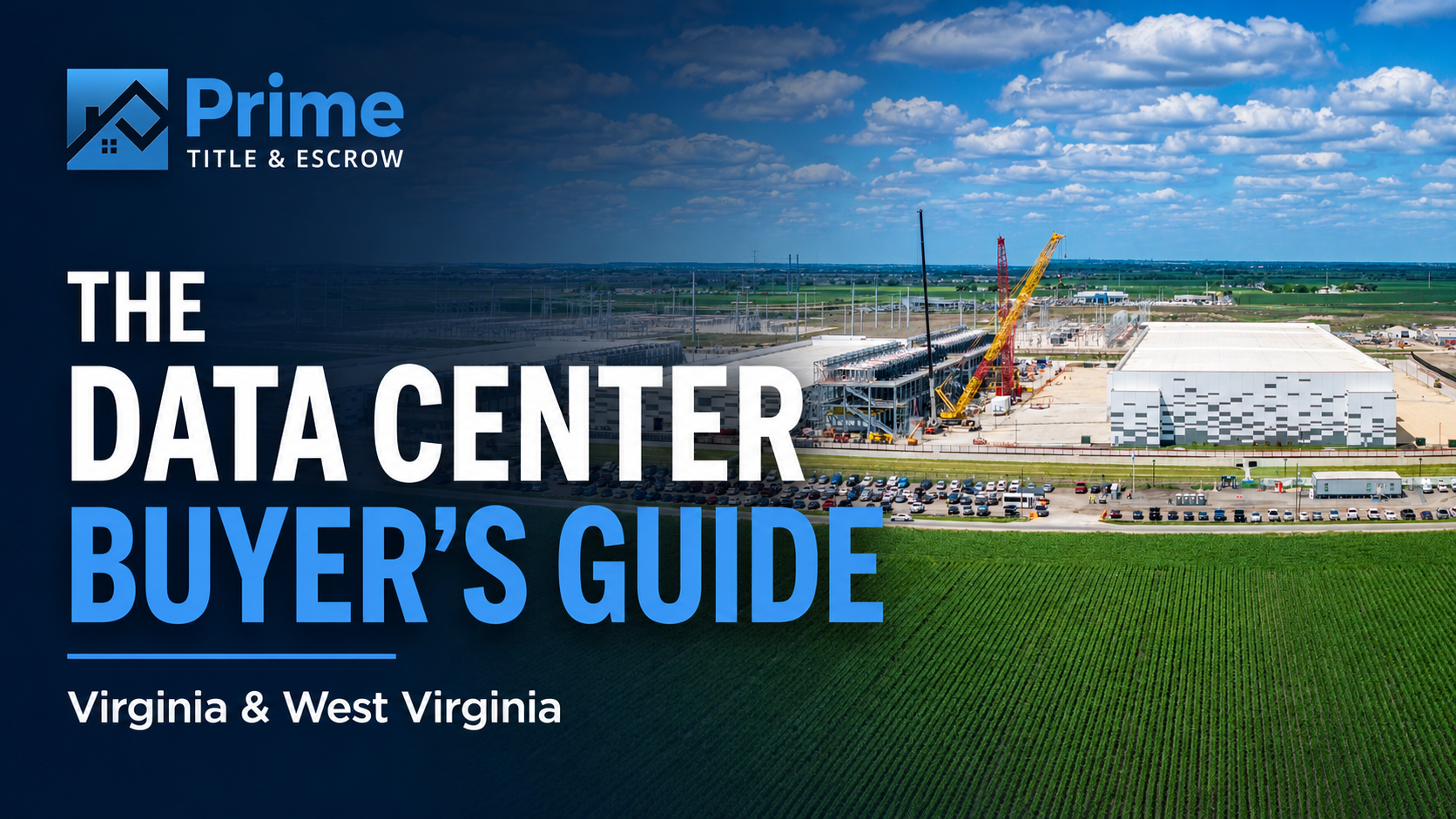
New from Anthony I. Shin, Esq.
Data Center Acquisitions in Virginia & West Virginia
The full regional playbook behind this page: power, fiber, zoning, title, taxes, and the closing, region by region from Data Center Alley to the Eastern Panhandle, including Loudoun's 2025 zoning reset, West Virginia's new microgrid law, and the transfer tax math in both states.
Read the Buyer's Guide
What Prime handles
Commercial title and settlement, from opening through recording.
- Title search and commitment
- ALTA survey coordination
- Exception and requirement tracking
- Easement and access review
- Entity and signing authority
- Escrow deposit management
- Lender coordination
- Payoff and release coordination
- Closing statements
- Secure funding
- Document recording
- Final title-policy issuance
How your purchase closes
Five steps, handled with care from open to record.
1
Open and order
Send us your contract or LOI and entity documents. We open the file and order the title search and survey.
2
Commitment and survey
We issue the title commitment and review the ALTA survey and recorded easements, power, fiber, and access included, for encroachments and gaps.
3
Diligence and curative
We clear liens and judgments, confirm entity authority, and check for mechanic's lien exposure.
4
Coordinate the close
We align your lender, counsel, and any intermediary, and confirm the figures and Virginia recordation taxes.
5
Fund and record
We protect and disburse the funds, record the documents, and deliver your insured title.
Personalized to your seat
What this means for your team.
Operational confidence:
Know whether the recorded rights support the operation before closing.
Better risk visibility:
Understand the recorded rights and restrictions that can affect the build, the lease-up, and the exit.
Controlled execution:
Maintain consistent title, escrow, approval, and reporting procedures at the scale these files run.
Transaction alignment:
Sequence the facility transfer with the wider platform or company acquisition.
Decision-ready information:
See material risks, costs, deadlines, and funding requirements without the document dump.
Cleaner coordination:
Track title, survey, easement, entity, lender, escrow, and recording items on one list.
Why buyers choose Prime
Local knowledge, legal judgment, and no divided loyalty.
Local to Data Center Alley
Based in Leesburg, in the heart of Loudoun County, we know Virginia's commercial market and its closings firsthand.
Attorney-led
Real estate attorneys oversee your file, so complex title and structure questions get legal judgment, not guesswork.
Independent and neutral
No affiliated arrangements and no divided loyalty. Our only focus is your transaction and a clean close.
Funds protected
Secure escrow and verified instructions guard the large wires that commercial deals depend on.
Commercial buyer questions
What Virginia commercial buyers ask us.
Who pays Virginia's recordation and transfer taxes on a commercial purchase?
As the buyer, you pay the state recordation tax on the deed, set at $0.25 per $100 of value, plus any local recordation tax and the recordation tax on your deed of trust. The seller generally pays the grantor's tax, and Northern Virginia jurisdictions add regional fees such as the WMATA capital fee and the regional congestion relief fee. We calculate the exact amounts for your jurisdiction and handle the recording.
Do you coordinate ALTA surveys?
Yes. We order and review the ALTA survey for easements, encroachments, and legal access, and we add the title endorsements your lender requires based on what the survey shows.
Can you close a deal held in an LLC, partnership, or out-of-state entity?
Yes. We confirm signing authority, prepare the documents each structure needs, and work through any Virginia registration questions with your counsel so authority is never in doubt at closing.
Do you review power and fiber easements?
We review what the record grants: utility, transmission, and conduit easements, where they run, what they allow, and whether they reach the site. Capacity, interconnection, and utility contracts sit with your engineers and the utility, and we coordinate our review with them.
The deal includes expansion land. How do you make sure it transfers?
We tie the legal description to the survey and the contract, parcel by parcel, so every phase you priced is inside the deed before you sign. If an outparcel is missing or misdescribed, you hear it from us early.
Can you handle a 1031 exchange?
Yes. We coordinate with your qualified intermediary, prepare the closing to fit the exchange, and protect your identification and closing deadlines.
How do you protect a large commercial wire?
We hold funds in secure escrow, use verified wiring instructions, and confirm details with you by phone before anything moves. We will never send new instructions by email, and we ask you to call us before you wire.
Do you work with our lender, broker, and attorneys?
Yes. We coordinate with every party in the deal, keep the title and escrow side on schedule, and make sure each requirement is met before closing day.
Role-specific questions
Questions from your seat at the table.
Can you confirm the site can support our operations?
We confirm what the record supports: the easements, access, restrictions, and parcels that run with the land. Power capacity, utility contracts, and county approvals sit with your engineers, the utility, and land use counsel, and we coordinate our title work with them.
We need possession by a certain date. Can the closing be built around it?
Tell us the date and we sequence signing, funding, and recording around it, as far as the parties and the lender allow. If something threatens the date, you hear it from us early, not at the table.
How early should Prime see a data center deal?
At the letter of intent. A title order can open before the contract signs, so the commitment, the survey, and the easement review start ahead of your diligence clock instead of inside it.
Loudoun changed the zoning rules. What does that mean for the title work?
We confirm every recorded restriction, condition, and easement the record carries, so the title side is ready whichever way the approval path runs. Hearings, special exceptions, and county approvals themselves run through your land use counsel.
Can you run our committee and fund approval chain through closing?
Yes. We collect and verify formation documents, resolutions, and signing authority for each entity in the structure, and we build the escrow instructions and signature blocks to match your approval process.
How do you manage escrow at this scale?
Deposits are held under written instructions, disbursed only when the stated conditions are met, and documented on the settlement statement, with wire instructions verified by phone before any funds move.
The data centers transfer inside a platform acquisition. What changes?
The structure decides the paperwork. An asset deal moves the facilities by deed; an equity deal moves the entities that own them. Either way, title, liens, and authority still have to be confirmed, and we coordinate that with deal counsel.
Can the facility closings track the corporate date?
We sequence title, escrow, funding, and recording to the deal calendar and flag the dependencies, like lender releases and third-party consents, that sit outside our control.
What reaches my desk during the closing?
The short list: the title matters that are actually unresolved, the funding requirement, the dates that move money, and the honest state of closing readiness, from named people you can call.
How is a wire of this size protected?
Instructions are verified by phone with a known contact, never changed on an email alone, and funds move only when the closing conditions are met and documented.
Do you coordinate the ALTA survey and Table A items?
Yes. We order and coordinate the survey, set the Table A scope with you and the lender, and review the result against the commitment so survey matters and exceptions reconcile before closing.
How are curative items tracked?
Through the updated title commitment and a running open-items list shared with counsel and the lender, so every requirement, exception, and curative document has an owner and a status before closing week.
Make sure the site supports the operation.
Tell us how the facility will be used, who will own it, and when you need possession.
Clear the rights before the capital commits.
Send Prime the contract, the development plan, the financing timeline, and the diligence deadlines.
Bring Prime into the acquisition process.
Coordinate title, survey, entity, escrow, and closing requirements through one attorney-led team.
Align the facility with the corporate closing.
Tell us how the data center fits into the acquisition, platform strategy, or restructuring.
Get clarity on risk, timing, and funds.
Prime can provide a direct view of material title issues and closing readiness.
Put the title and survey work in motion.
Send the contract, entity documents, lender information, survey, and target closing date.
(703) 552-4155
118 Edwards Ferry Rd NE, Unit 210, Leesburg, VA 20176