
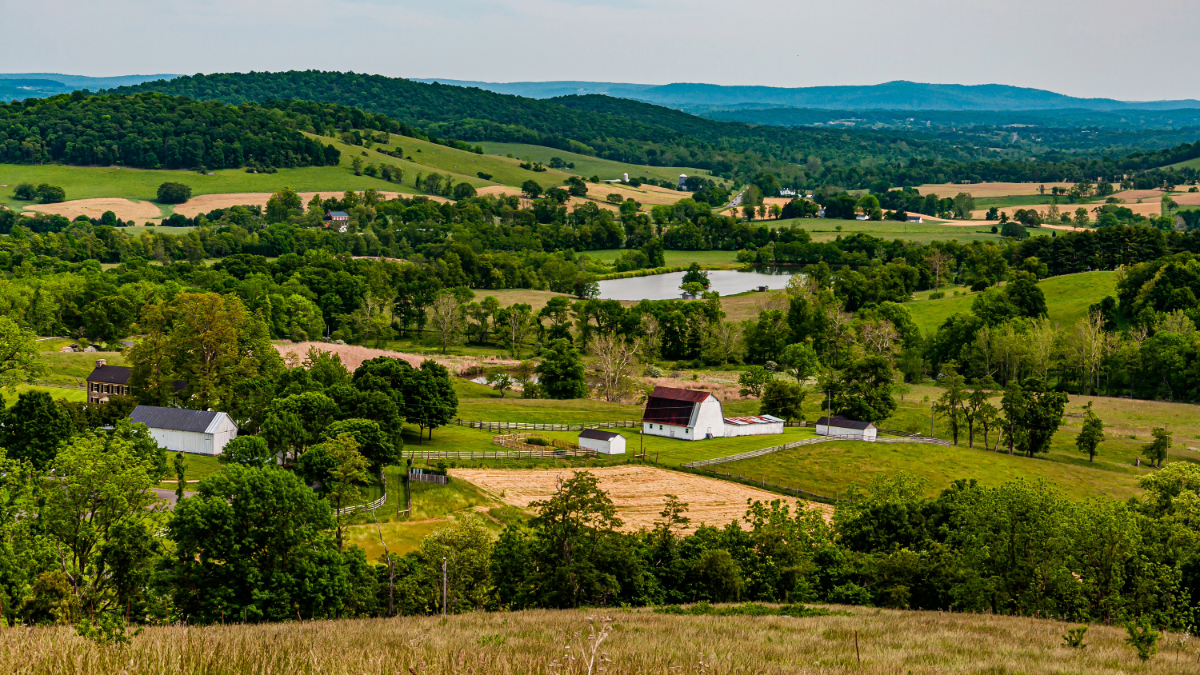
The Shenandoah Valley along the Interstate 81 corridor, from Winchester south through Harrisonburg to Augusta County, is no longer moving as one market. The northern gateway nearest the Washington exurban pull has begun to cool, while much of the central and southern Valley has held firm or kept appreciating. Here is my read on where the corridor stands in 2026, what the numbers say, and why clean title and a careful closing matter more when a market splits in two.
Written by Anthony I. Shin, Esq., Principal and real estate attorney at Prime Title & Escrow
The Valley is splitting into a softer northern gateway and a firmer central and southern corridor, and in both, a careful closing is what protects the deal.
The northern markets nearest the Washington pull, Frederick County, Winchester, Warren County, and Front Royal, show clear year over year price corrections, with Frederick County down 11.6 percent to a $398,000 median in March 2026, according to Redfin. The central and southern Valley has held firmer over the same window, with Augusta County up 9.8 percent, Waynesboro up 9.4 percent, and Woodstock up 11.6 percent, while Harrisonburg keeps turning over in about 16 days.
Mortgage rates near 6.5 percent remain the main constraint. Freddie Mac put the 30 year fixed at 6.52 percent on June 11, 2026, and Virginia Realtors report first time buyers feeling discouraged even as statewide listings rise. The likely path for the next 12 to 24 months is slow rebalancing, not broad decline, supported by population growth, manufacturing expansion, and Interstate 81 investment.
On the commercial side, industrial, cold chain, advanced manufacturing, and logistics lead the corridor rather than office, with named investments from Clasen Quality Chocolate, HP Hood, Innovative Refrigeration, and MSolar. In a market where affordability and rural complexity leave little room for error, the closing is where confidence is protected. Every figure below is attributed to its source, with the full list at the end.
I prepared this survey through the lens of a title and escrow office, because in the Shenandoah Valley a lower price than Northern Virginia does not remove closing risk, and on rural and historic parcels it often raises it. Boundary descriptions, private road access, floodplain rules, agricultural restrictions, and unreleased liens all show up here. My aim is not to predict the market. It is to show you what the data says, name every source, and point out where a careful closing protects you. Where the data does not tell us something, I say so rather than guess.
The residential snapshot
The single most important thing to understand about this corridor in 2026 is that it has stopped behaving like one market. The pandemic era pushed the whole Valley into tight, fast, seller-friendly conditions. That is over. In its place is a more selective, price-sensitive market that still has pockets of real competition, and the dividing line runs roughly north-to-south. The numbers below put that split in one view.
Read across the corridor and the pattern is consistent. The gateway counties closest to the Washington commute have given back the most ground from their peaks, while the central and southern Valley has mostly held or risen. The table below is the full submarket picture for the period.
| Submarket | Median sale price | Year over year | Days on market |
|---|---|---|---|
| Frederick County | $398,000 | Down 11.6 percent | 58 |
| Winchester | $361,495 | Down 9.6 percent | 48 |
| Front Royal | $392,450 | Down 9.8 percent | 40 |
| Warren County | $396,999 | Down 8.7 percent | 43 |
| Harrisonburg | $289,250 | Down 1.2 percent | 16 |
| Rockingham County | $336,500 | Up 2.0 percent | 56 |
| Shenandoah County | $340,000 | Up 2.1 percent | 54 |
| Strasburg | $320,000 | Up 3.2 percent | 42 |
| Waynesboro | $325,000 | Up 9.4 percent | 41 |
| Augusta County | $345,500 | Up 9.8 percent | 45 |
| Woodstock | $334,777 | Up 11.6 percent | 65 |
| Staunton | Not available this period |
Harrisonburg is worth singling out. Even with a median price slightly below a year ago, it remains one of the fastest moving submarkets in the corridor at about 16 days on market, which tells you the market is still liquid when a home is priced correctly. That is the recurring lesson of a rebalancing market: pricing and condition, not blanket urgency, decide outcomes.
Mortgage rates and affordability
Rates are the core affordability governor in this corridor. Freddie Mac reported the 30 year fixed mortgage at 6.48 percent on June 4, 2026 and 6.52 percent on June 11, 2026. That is below year ago readings but still high enough to restrain payment power, especially for first time buyers or households trying to stretch into larger lots, newer construction, or rural properties that may also need repairs, survey work, or septic review.
Across Virginia the market is loosening rather than collapsing. Virginia Realtors reported that statewide active listings in April 2026 were up by roughly 1,800 from a year earlier, while the statewide median sold price rose 3.5 percent year over year, and the group’s confidence survey found first time buyers discouraged by current economic conditions. In practice, that combination produces a market where move up and cash ready households stay active while first time buyers turn more sensitive to the monthly payment.
That sets up a fairly clear near term base case. If rates hold around the mid 6 percent range and inventory keeps inching upward, the most likely outcome over the next 12 to 24 months is modest nominal price movement and more market segmentation: the northern corridor staying softer than 2024 and 2025 because Frederick County, Winchester, and Warren County already show visible retrenchment, and the central and southern corridor staying firmer because Augusta County, Shenandoah County, Woodstock, Strasburg, and Waynesboro are still posting gains while Harrisonburg turns over quickly. This is an inference grounded in current rate, inventory, and submarket sales data rather than a published forecast, but the supports underneath it, population growth, manufacturing expansion, and Interstate 81 investment, are concrete.
Population and the Interstate 81 spine
Population trends explain a good deal of why the southern Valley has held firmer. Virginia’s 2025 estimates show statewide growth driven mostly by net migration, and several Valley localities have grown meaningfully since 2020. Frederick County’s latest Census snapshot showed 98,109 residents in 2024, up 7.3 percent from 2020; Waynesboro’s 2025 estimate was 23,951, up 7.9 percent; Rockingham County’s was 89,316, up 6.6 percent; and Staunton’s was 26,801, up 4.1 percent. Winchester city has grown far more modestly, with a 2025 estimate of 28,272, up 0.6 percent, which helps explain why some county markets remain more expansionary than their core cities.
The Virginia Department of Transportation describes Interstate 81 as a 325 mile corridor that carries more than one third of all trucks in Virginia and nearly half the value of goods moved on the state’s interstates, with 65 corridor improvement projects underway. Current work touches the study area directly, including the Harrisonburg area widening, the Staunton area widening, and widening plus interchange improvements near exit 317 north of Winchester. Jobs and travel time shape where households buy, and for industrial and logistics property, freight reliability and site readiness are core value drivers. You can see how I approach the commercial side in commercial title and settlement.
Regional divergence: north, central, and south
The clearest way to see the split is to line up year over year price change across the corridor. The gateway markets that ran hardest during the boom are giving back the most, while the central and southern Valley is still adding value.
The reason for the divide is mostly about exposure. The northern gateway is tied most tightly to the Washington commute and the exurban price run up, so it is the part of the corridor correcting hardest as payments tightened. The central and southern Valley leans on a broader base of local employment, manufacturing, and agriculture, which has kept demand and prices steadier. For a buyer or seller, the practical message is that a Valley address tells you very little on its own. The submarket, the price band, and the condition of the specific home decide whether you are in a softening market or a competitive one.
What buyers are facing
The buyer challenge in this corridor is getting more regional and more practical. In city markets like Harrisonburg and Winchester, the issue is often payment shock, competition for well priced homes, and a lower tolerance for cosmetic or inspection surprises. In county and town markets, the issues broaden considerably: whether the parcel boundary shown on the county map matches recorded plats, whether road access is public or private, whether a family lot or older subdivision arrangement affects frontage, whether floodplain rules apply, and whether the land sits in an Agricultural and Forestal District or similar protected status.
A rural or semi rural purchase here carries questions a finished suburban home never raises, from access and septic to plats and land use status. None of it should stop a good purchase, but all of it should be checked before closing rather than discovered after. My guides to buying land or a vacant lot and to survey, appraisal, and inspection walk through that diligence, and a first time buyer can start with my first time buyer guide.
What sellers are facing
Sellers still have price growth on their side in much of the central and southern Valley, but they cannot assume every listing moves instantly. Many submarkets now show longer marketing times than a year ago, even where prices are up, which is the clearest sign that the era of automatic sales is over.
Scarcity in the right neighborhood and price band still helps a seller, but overpricing is more likely to produce a stale listing, concessions, or a price cut than it was a year ago. The other half of a smooth sale is clearing title problems early, before a buyer is at the table, so an unreleased lien or a boundary question does not surface at the worst moment. I walk through that cleanup in clearing title before you sell.
Commercial real estate
Industrial, logistics, cold chain, and advanced manufacturing are the strongest commercial story in the corridor, not traditional office. Frederick County’s pipeline alone includes Clasen Quality Chocolate’s $230 million facility with 250 jobs, a completed 83,000 square foot cold storage expansion by WCS Logistics, a planned 160,000 square foot production facility by ZM Sheet Metal on 23 acres, and an $83.5 million dairy processing expansion by HP Hood. Augusta County added a $19 million Innovative Refrigeration expansion expected to create 214 jobs, Harrisonburg added a $2.5 million AeroNimble aviation manufacturing expansion with 51 jobs, and Shenandoah County landed a $23.775 million MSolar manufacturing facility in Mount Jackson planned at 56,000 square feet and 150 jobs.
Data centers are best described as an emerging land use pressure here rather than a delivered property type. Frederick County has established a public data center information page, held work sessions, and published a County Attorney memorandum on how zoning tools can regulate data centers, which means the north end of the corridor is now part of Virginia’s wider data center conversation. For now the real estate effect is more about rezoning, power, water, and public acceptance than about operating campuses.
In a corridor where a parcel can move from farm, to light industrial site, to logistics use, the due diligence that decides value happens early: zoning and conditional use, utility availability, access and weight limits, survey coordination, easements, and title curatives. That is the heart of a commercial closing, which I describe in what my commercial practice handles.
Retail is more market specific. Virginia Realtors reported that statewide retail net absorption turned negative in the fourth quarter of 2025 with vacancy trending up, but that statewide cooling does not erase the importance of downtown placemaking in the Valley’s historic cores. Staunton is the clearest example, having redesigned its enterprise zone incentives effective January 1, 2026 and used the Beverley Street demonstration project and seasonal street closures to strengthen pedestrian trade. Office, by contrast, is the weakest and least transparent sector in local data: statewide office vacancy was flat in the fourth quarter of 2025 while rents softened, and the accessible Valley evidence is mostly small and mid sized suites in Harrisonburg, Staunton, Waynesboro, Verona, and Rockingham marketed in the mid teens to low $20s per square foot. This is a fragmented, owner user and adaptive reuse market, not a trophy office market, a point reinforced by the Arcadia Project’s restoration of a historic Staunton theater as a community venue.
Farmland and agribusiness
Farmland is not a side story in this corridor. It is a foundational real estate force. The 2022 Census of Agriculture shows Rockingham County with about $1.197 billion in agricultural products sold, the highest total in Virginia, followed by Augusta County at $448.3 million, Shenandoah County at $224.7 million, and Frederick County at $50.6 million. The statewide rankings list Rockingham as Virginia’s top county for total farm sales, for poultry and eggs, and for milk from cows, while Frederick leads the state in fruits, tree nuts, and berries.
Shenandoah, Augusta, and Frederick counties all run Agricultural and Forestal District programs, and enrollment, though voluntary, binds the land to agricultural or forestry use for a defined period and limits more intense development or subdivision during that term. Shenandoah County alone has more than 39,000 acres enrolled. On a commercial or large lot residential deal, those restrictions can change what a buyer believes the future development or exit path will be, so they belong in the title review, not the closing day surprise pile.
The interaction between agriculture and the Interstate 81 industrial build out is one of the quieter stories in the corridor. Manufacturing and cold chain growth support agribusiness supply chains, while also raising pressure on interchange adjacent farmland values and the conversion decisions that come with them. For owners of land near an interchange, that tension is exactly where careful title work, accurate boundaries, and a clear read on land use status pay off.
Title and closing risks in the Valley
The Shenandoah Valley has a particularly strong case for title forward transaction management, because the risk profile is often specific to the property rather than generic. The work behind a clean closing is heavier than most buyers expect. The American Land Title Association’s 2026 study found that title production is document intensive and curative heavy, with many purchase files requiring review of 11 or more documents, a majority needing several title issues cleared, and a mortgage payoff involved in the large majority of transactions.
Shenandoah County states plainly that its parcel data is for informational purposes only, is not a legal description, and may contain inaccuracies, and it directs users to the Clerk of the Circuit Court for deeds and plats. Rockingham County likewise says its GIS data is regularly revised and not warranted for accuracy. For a title company that means recorded plats, survey review, easements, and deed interpretation can materially affect a closing, especially on older tracts. I cover how this plays out in boundary disputes and encroachments and in what a title search traces through the chain of title.
Access and subdivision configuration are another recurring Valley issue. Augusta County’s subdivision guidance notes that family member exception lots can be created without the normal 50 feet of road frontage in some cases, and Shenandoah County emphasizes that land division depends on streets, utilities, parcel size, and ordinance compliance. Virginia law even includes a Shenandoah specific procedure, in Section 15.2-2257 of the Code of Virginia, allowing the circuit court to modify certain subdivision road maintenance covenants. Those are concrete signs that private road obligations, frontage exceptions, and subdivision document review are not hypothetical here. An undocumented right to cross a neighbor’s land is the kind of gap I look for, which is why I explain how easements affect your property.
Floodplain review matters in this corridor too, because town growth often follows the rivers and valley floors. Rockingham County regulates development in FEMA designated 100 year floodplain areas and requires that development not raise the base flood elevation by more than one foot, and Shenandoah County directs buyers to floodplain information as part of parcel review. Floodplain status can affect insurance cost, financing, use rights, and closing timing, so it is worth knowing before a contract, not after. Utility and service area review carries similar weight: Frederick County’s mapping includes sewer and water service area boundaries, and whether public service is available, planned, or merely assumed can decide whether a lot split or an industrial use is even feasible.
The FBI identifies business email compromise as one of the most financially damaging online crimes and specifically lists fake title company wire instructions as a standard scam pattern. The defense is simple and it works: verify wiring instructions by calling a known number before you send, and never trust instructions that arrive or change by email. I walk through the specifics in sending your closing funds safely.
What this means if you are closing here
Pulling it together, the Shenandoah Valley rewards preparation. Affordability and rural nuance leave buyers little room for last minute surprises, so clean title and secure escrow matter from the start. Sellers need title issues resolved early so a strong offer does not fall apart before closing. And commercial buyers and developers face deeper due diligence as manufacturing, logistics, agribusiness, and a live data center conversation reshape parts of the corridor. The Valley is more affordable than Northern Virginia, but the closing is where that affordability is either protected or put at risk.
That is the work I do: independent, attorney led title and escrow for residential and commercial closings, built around clear title, protected funds, and a process you can follow from opening the file to recording the deed. In a corridor where more deals involve rural nuance, historic chains of title, industrial land, and agricultural restrictions, my job is to translate those risks into plain English and keep the transaction stable. If you want the basics of how that works, start with what a title and escrow company does, and for the coverage that protects your own equity, read owner’s versus lender’s title insurance.
Whether it is a home in Harrisonburg or Winchester, a rural parcel, or an industrial or agribusiness deal along Interstate 81, send me the details and I will give you a clear, transparent path from contract to recording.
Get Your Free Quoteor call (703) 552-4155Frequently asked questions
Is the Shenandoah Valley a buyer’s market or a seller’s market in 2026?
It is splitting. The northern gateway around Frederick County, Winchester, Warren County, and Front Royal has cooled, with year over year price declines and more negotiation room for buyers. Much of the central and southern Valley, including Augusta County, Waynesboro, and Woodstock, has held firmer or kept appreciating, so conditions still favor well prepared sellers there.
Why are home prices falling in the northern Valley but rising farther south?
The northern markets are most exposed to the Washington area commuter pull and ran up fastest during the pandemic years, so they are correcting from higher peaks now that rates sit near 6.5 percent. The central and southern Valley is supported by population growth, manufacturing expansion, and agriculture, which has kept demand and prices firmer.
What should I check before buying a rural property in the Shenandoah Valley?
Confirm the legal boundary against recorded plats rather than the county GIS map, check whether road access is public or by recorded easement, look for floodplain designation, and find out whether the parcel is enrolled in an Agricultural and Forestal District that limits development. A title search and survey review surface these before closing.
What is an Agricultural and Forestal District and how does it affect a purchase?
It is a voluntary enrollment that binds the land to agricultural or forestry use for a set period and limits more intense development or subdivision during that term. It does not block most sales, but it can change what a buyer can do with the land later, so it belongs in the title review.
Are the property boundaries on a county GIS map reliable?
No. Shenandoah County and Rockingham County both state that their GIS data is for information only, is not a legal description, and may contain errors, and they direct you to the Clerk of the Circuit Court for deeds and plats. The recorded plat and a survey, not the GIS map, establish the legal boundary.
How do I protect my money from wire fraud at a Valley closing?
Verify wiring instructions by calling a known number for the title company before you send, and never trust instructions that arrive or change by email. The FBI lists fake title company wire instructions as a common scam, and confirming by phone is the most reliable defense.
We close throughout the corridor. For the local detail on where your deed records, the recordation and grantor taxes, and what to check in your jurisdiction, see the page for your city, county, or town.
Cities: Winchester, Harrisonburg, Staunton, and Waynesboro.
Counties: Frederick, Warren, Shenandoah, Rockingham, and Augusta.
Towns: Front Royal, Strasburg, and Woodstock.
Sources
Every figure in this survey is drawn from the sources below, current as of the dates shown. Where a source did not provide a figure, I have left it out rather than estimate.
American Land Title Association. (2026, March). Measuring the complexity of title production, and Behind every closing: the complex work of clearing title.
Augusta County, Virginia. (n.d.). Agricultural and forestal districts; Subdivision of land; Land records.
City of Staunton, Virginia. (2026). Enterprise zone; Reimagine Beverley Street and Beverley demonstration project; Staunton Downtown Development Association, Shop and Dine Out.
Code of Virginia. (2026). Section 15.2-2257, procedure to modify certain covenants in Shenandoah County.
Cottonwood Commercial and Lee and Associates. (n.d.). Harrisonburg, Staunton, Waynesboro, and Verona office listings.
Federal Bureau of Investigation. (n.d., and 2025, April 23). Business email compromise; Annual internet crime report.
Freddie Mac. (2026, June). Primary Mortgage Market Survey, June 4 and June 11, 2026.
Frederick County, Virginia, and Frederick County Economic Development Authority. (2026). Data center information; Agricultural and forestal district committee; Locations and expansions; Advanced manufacturing.
Office of the Governor of Virginia. (2026, June 4). Governor Spanberger announces $23 million investment by MSolar in Shenandoah County.
Redfin. (2026). Housing market data for Frederick County, Winchester, Warren County, Front Royal, Shenandoah County, Strasburg, Woodstock, Rockingham County, Harrisonburg, Augusta County, and Waynesboro, Virginia.
Rockingham County, Virginia. (n.d.). Floodplain; GIS data and maps; Land records division.
Shenandoah County, Virginia. (n.d.). GIS and parcel data; Agricultural and Forestal Districts; Zoning and subdivision.
U.S. Census Bureau. (2026). QuickFacts for Frederick County, Rockingham County, Staunton, Waynesboro, and Winchester, Virginia.
U.S. Department of Agriculture, National Agricultural Statistics Service. (2025). 2022 Census of Agriculture county profiles for Augusta, Frederick, Rockingham, and Shenandoah counties; Virginia rankings of market value.
Virginia Department of Transportation. (2026). Interstate 81 program; Harrisonburg area widening; Staunton area widening; exit 317 interchange improvements, Frederick County.
Virginia Economic Development Partnership. (2025, and 2026). Clasen Quality Chocolate; AeroNimble; Innovative Refrigeration Systems.
Virginia Realtors. (2026). April 2026 home sales report; Realtor confidence survey; Q4 2025 commercial market reports.
Weldon Cooper Center for Public Service, University of Virginia. (2025, and 2026). 2025 Virginia population estimates; Virginia population projections.
WMRA. (2026, June 4). Arcadia Project working to reopen historic Staunton theater.
This survey is general market information for the Shenandoah Valley of Virginia, not legal, financial, tax, or investment advice for any specific transaction. Market data is attributed to third party sources and reflects the dates and geographies those sources describe. Please confirm anything you intend to rely on, and reach out to me directly with questions about your own closing.