

The office market repriced, and the buyers who came back read title work the way lenders read tax returns. Today’s office buyer underwrites everything: the garage agreement, the shared systems, the tenant rights, the condominium declaration, the restrictions that would block a conversion, and every lien a decade of tenant build-outs left behind. And in Virginia, the seller across the table is rarely a tower REIT. It is a law firm funding partner retirements, a physician group whose practice just merged, a defense contractor whose footprint no longer fits the contract. This is my guide to selling office property in Virginia and West Virginia, written for the professionals who actually own it.
Written by Anthony I. Shin, Esq., Principal and real estate attorney at Prime Title & Escrow
Basis buyers underwrite everything, so the price no longer defends itself. The record does, and the seller who answers it first keeps the price defensible and the clock moving.
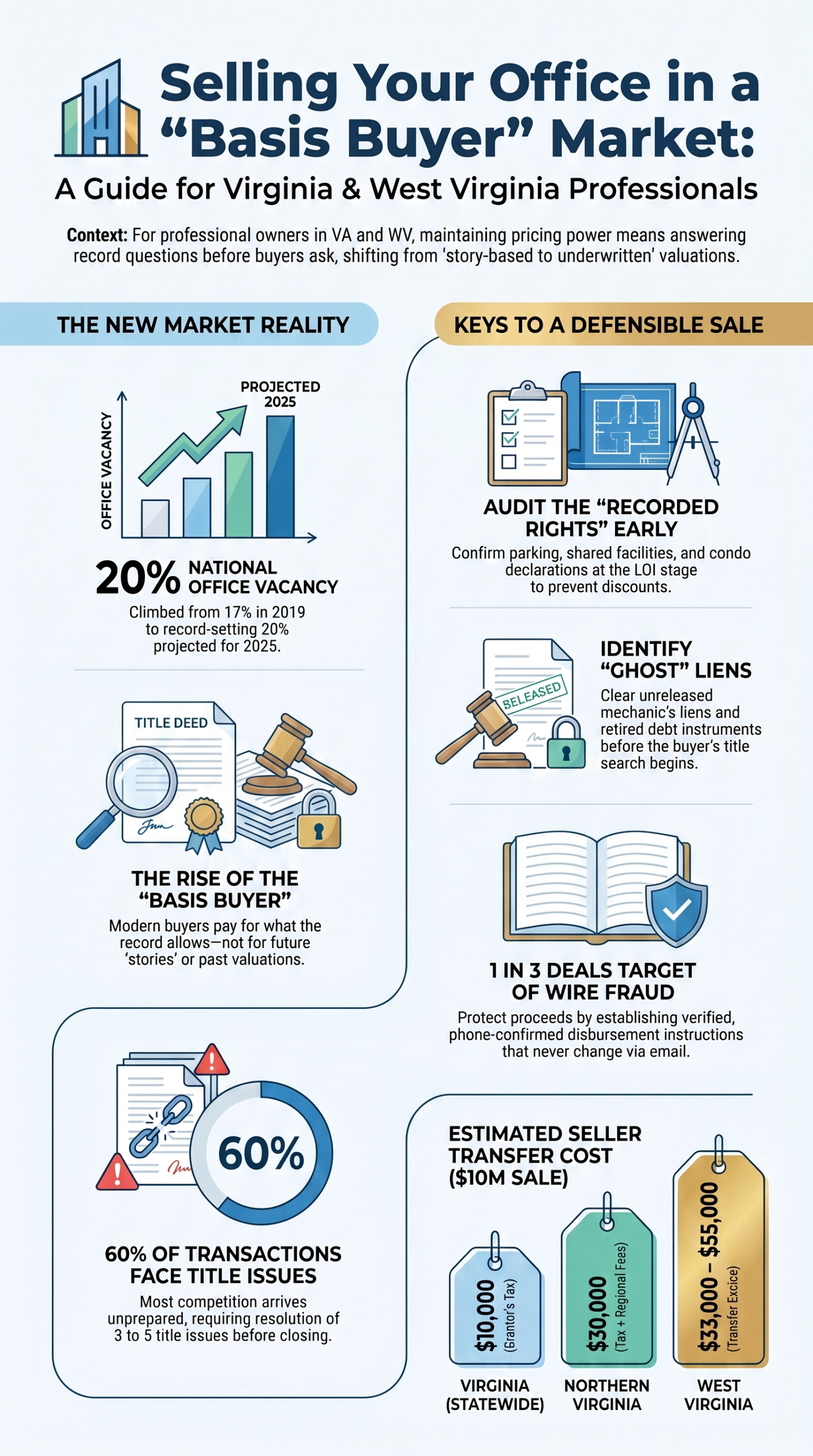
Hybrid work settled at about 28 percent of paid workdays per WFH Research, national office vacancy set records near 20 percent per Moody’s, and the buyers circling repriced office are paying for what the record allows, not for the story. Meanwhile the sellers in this market are professionals: law firms, medical groups, defense and federal contractors, and associations, whose reasons for selling usually have more to do with the practice than the property, and whose ownership structures put real questions in the file.
This guide walks the office sell side in order: who is selling and why it matters, the parking and shared facilities, the condominium, the tenant rights that can reach the sale, the sale-leaseback, the releases, the debt, the partner-owned entity, the exchange decision, the two states, the money, and the proceeds. Every figure is attributed to its source, with the full list at the end. This is general educational information, not legal, tax, lending, healthcare regulatory, government contracting, or security advice for any specific transaction.
I wrote this because the office sellers I meet are not real estate people. They are attorneys, physicians, engineers, and executives whose building was a good decision twenty years ago and is now a question their practice, their partners, or their contract portfolio has to answer. My office buyer’s guide shows you exactly what the other side will read. This one is your side of the table, the record, the parking, the estoppels, the payoffs, the escrow, and the disbursement, run end to end. Leasing strategy, building condition, and price belong to your broker and the buyer’s diligence, and the decisions inside your practice belong to you and your counsel. Where the record does not answer a question, I say so, and I point it to the right professional.
Why do office buyers underwrite everything now?
Because the price no longer defends itself. Before 2020, an office rent roll carried a valuation on its own back: stable tenants, predictable renewals, a capitalization rate everyone could live with. Then hybrid work reset the demand and vacancy set records, and the buyers who came back are basis buyers, purchasing below replacement cost with a plan, reposition, re-lease, convert, hold. A basis buyer is not paying for your story about the building’s future. They are paying for what the record allows them to do with it, and every unanswered question in that record, the garage agreement, the tenant option, the condominium consent, the conversion-blocking covenant, is a reason to pay less.
That reframes the seller’s job. You cannot argue office back to 2019 pricing, but you can control the one variable that moves the number you actually get: certainty. The seller who pulls the record at the letter of intent answers from documents, keeps the diligence clock from spending the price, and meets basis buyers with the thing basis buyers respect, a file with nothing left to discover. That is the discipline behind my office disposition service, and this guide is the long-form version of it.
Who is selling office in Virginia? Attorneys, doctors, and contractors
Mostly professionals, selling for reasons that have more to do with the practice than the property. The law firm whose founding partners are retiring, and whose building, owned through a side entity since 2004, turns out to have been the pension all along. The physician group whose practice just sold to a hospital system or an investor-backed platform, with the real estate trading separately because the buyers of practices and the buyers of buildings are different people. The defense contractor whose footprint no longer fits after telework reset the seat count, or after a recompete went the wrong way. The government contractor consolidating three suites into one. The association or nonprofit whose headquarters is worth more than its mission needs it to be. The accounting firm merging up into someone else’s lease.
Each seller type puts its own questions in the file. Law and medical practices almost always involve a two-entity structure, the practice as tenant, a separate entity as owner, which is a whole chapter below. Medical sellers carry a lane note: when the practice and the property trade around the same event, healthcare regulatory constraints on how the two deals can be priced and papered belong squarely to your healthcare counsel, and our job is having the building’s record, debt, and closing ready whenever the practice deal is. Defense and federal contractors bring the sharpest version of the fixture question in this whole series: a sensitive compartmented information facility, the secure space a cleared contractor builds, conveys as an improvement, the walls and the wiring transfer with the deed, but accreditations belong to programs and sponsors, not to real estate, so the buyer is acquiring the buildout, not the capability, and the contract should say so plainly.
How we help: tell us who you are and what is actually driving the sale, the retirements, the practice transaction, the contract calendar, and we build the file around it, because a closing designed for a REIT does not fit a three-partner medical group, and a good one never pretends it does.
What is the office market telling sellers?
Two numbers, and one instruction. Hybrid work settled at about 28 percent of paid workdays worked from home, per WFH Research, and that share stopped falling, which means the demand reset is structural, not cyclical. National office vacancy climbed from about 17 percent in 2019 to about 19 percent in 2022 to roughly 20 percent in 2025, per Moody’s, a record. The instruction hiding in those numbers: the buyers still active in office are serious, disciplined, and reading everything, which is exactly why a clean, answered record is the seller’s best remaining source of pricing power.
One more market fact works in your favor. The American Land Title Association reports that nearly 60 percent of transactions need three to five title issues resolved before closing, which means most of your competition for the buyer’s attention arrives unprepared. In a buyer’s market, being the prepared seller is not a courtesy. It is a price strategy.
Does the parking garage convey with the building?
Only if the record says so, and the buyer’s first question is whether it does. In office markets built around structured parking, the garage frequently sits on its own parcel, under a condominium regime, or inside a shared agreement with neighboring buildings, and the spaces your tenants use every day convey only through the recorded instruments: the parking agreement, the easement, the allocation exhibit. A building whose parking is a recorded right is an asset. A building whose parking is an arrangement is a question, and in this market questions are discounts.
The same logic runs through everything your building shares with its neighbors: the plaza, the loading dock, the driveway, the chilled water plant, the cross-easements that let two towers behave like one project. Those recorded agreements follow the sale, they carry cost allocations and consent provisions, and the buyer’s counsel will read every one. How we help: we pull the recorded parking, garage, and shared-facility set at the letter of intent, confirm the spaces, the terms, and the transfer provisions from the record, and put the answers in front of the buyer’s team before they ask, so your counsel and theirs are looking at the same picture from week one.
How do you sell an office condominium?
Through the declaration. An office condominium, the structure many law firms, medical practices, and small contractors actually own, is governed by a recorded declaration under the Virginia Condominium Act in Title 55.1, Chapter 19, or West Virginia’s Uniform Common Interest Ownership Act, and selling the unit brings the whole regime into the file: the declaration and its amendments, the association, the assessment ledger, any rights of first refusal the documents give the association or other owners, and the certificates and disclosures the statutes require for the transfer.
The seller-side traps are specific. An assessment ledger that is not current becomes a lien conversation. A special assessment the board is discussing but has not levied becomes a disclosure and negotiation point better raised by you than discovered by them. And a consent or refusal right in the declaration becomes a clock, one that starts when notice is given and does not compress for your closing date. How we help: we pull the declaration and amendments early, confirm the assessments and any association consents or certificates, and clear the condominium items before closing week, so the association is a formality in your file instead of a surprise in theirs.
Which tenant rights can reach the sale itself?
Three kinds: purchase rights, portfolio-shaping options, and the special mechanics of a government tenant. A right of first refusal or first offer recorded through a memorandum can reach your transaction directly, converting your signed contract into the tenant’s opportunity on a defined clock. Expansion, contraction, and termination options do not touch the deed, but they reshape what the buyer is buying, and they surface in estoppels whether or not anyone flagged them. And if the federal government is your tenant, the lease does not assign like a private lease: the transfer runs through the government’s own process, on the government’s timeline, and buyers and their lenders underwrite a government lease differently than any other tenancy. If your tenant is an agency, start that process first, not last.
Estoppels are where the file gets tested. The contract and the buyer’s lender will want certificates, each one confirms in writing what your rent roll has been claiming, and every discrepancy, the concession, the disputed operating expense reconciliation, the option nobody flagged, is better reconciled by you before the buyer reads it. How we help: we build the estoppel tracking list at the front of the file, coordinate collection with your manager, put lease rights that could reach the transaction in front of your counsel early with the response periods calendared against the contract, and confirm the package through the escrow before funding.
Can we sell the building and keep the practice in it?
Yes, and for professional practices the sale-leaseback is often the whole point: the building funds the retirements while the firm keeps its address, its signage, and its clients’ habits. Understand what actually changes at that closing. The practice stops being an owner with a mortgage and becomes a tenant with a landlord, on the day the deed records, under a lease that will govern the office for decades, and the buyer is not really buying a building. They are buying your lease, underwritten against your practice’s credit, which is why the rent, the term, the options, and the maintenance allocation are deal terms negotiated with the price, not paperwork signed after it.
The closing mechanics invert in small, important ways: the estoppel and the subordination and non-disturbance agreement the buyer’s lender wants are about you, and the fixture schedules matter double, because the practice is about to be a tenant surrounded by improvements the documents had better describe correctly. How we help: we run the title, payoff, and release work exactly as on any disposition, coordinate the lease execution into the closing sequence so the deed and the lease are born together, and make sure the recorded memorandum, the SNDA, and the settlement statement all describe the same deal your counsel negotiated. Lease strategy belongs to you and your counsel. Landing it at the table belongs to us.
Why are there liens for work we already paid for?
Because paying a contractor does not update the record. Only a recorded release does, and office buildings generate more small construction than any asset except retail: a tenant-improvement build-out on every new lease, lobby refreshes, systems upgrades, the suite you reconfigured twice. Each project leaves contractors, and sometimes their financing, in contact with your record, and after a decade the title search reads like a scrapbook: a mechanic’s lien from a dispute settled in 2018, a deed of trust from an improvement loan retired years ago, financing statements that outlived their equipment. In Virginia, a mechanic’s lien under Title 43 relates back to when the work began, and West Virginia’s Chapter 38, Article 2 framework carries the same essential threat for recent work.
The buyer’s title company cannot insure over what the record still shows, so every ghost becomes a commitment requirement, and chasing a release from a contractor who retired or a lender that merged twice is a project measured in weeks. How we help: we identify every unreleased instrument in the first title run, open the chase immediately, prepare curative documents where the original holder is gone, and track each release to recording, so the commitment comes back clean while the deal is still young.
How do the payoff and the lien releases actually work?
In writing, early, and to the day. We request payoff letters with per-diem figures from every holder, because on building-scale debt a week of interest is real money, and verbal payoff figures are not figures. Professional practices add a wrinkle worth naming: owner-occupied buildings are often financed through small business lending programs whose structures put liens on both the real estate and the practice’s assets, and sometimes cross-default with the practice’s operating lines, so the release work has to separate the building’s debts from the business’s debts cleanly, on paper, before closing week.
Prepayment economics, whether an assumable below-market loan is part of your price, and the choice between payoff and assumption belong to you and your debt advisors. What belongs to me is the landing. How we help: we obtain payoff and release requirements in writing directly from every holder or servicer, obtain partial-release terms wherever debt crosses other property, build the figures into the settlement statement to the day, and sequence the funding so the releases, the deed, and the buyer’s financing record in the right order.
What if the partners own the building, not the practice?
Then the seller is an entity most of its own members have not thought about in years, and that entity, not the practice, controls the closing. The standard professional structure separates the two: the practice operates and pays rent, while a side LLC or partnership owns the real estate, and its membership is usually some, but not all, of the practice’s partners, frozen at whoever bought in when the building was purchased. Retired partners still own pieces. A deceased partner’s interest sits in an estate. The operating agreement, drafted decades ago, decides who must consent to a sale, how proceeds split, and what happens to the partner who wants out early, and none of it has been read since the closing that created it.
Buyers prove they can pay. Sellers prove they can convey, and here the proof is a document set: the entity’s formation records, the consents its own agreement requires, incumbency for the signers, qualification papers where an estate holds an interest, and a federal screen if any owner is a foreign person, since the buyer generally must withhold part of the price at the table under the Foreign Investment in Real Property Tax Act. How we help: we untangle the ownership at the contract stage, confirm authority and collect the documents for every member, trustee, and executor, and keep a signature list with a status beside every name, so a closing that depends on a retired partner in another state never finds that out in closing week.
Selling into a 1031 exchange, or deliberately cashing out
Divesting is a decision about the money’s next job, and office sellers face it with a complication: the owners are usually several people at different stages of life. Some want to exchange into more real estate, on the statute’s unforgiving clock, 45 days from closing to identify replacement property and 180 days to close on it, both measured from the day the deed records. Some want to be done and will pay the tax on purpose, because the whole point was to stop. Paying the tax on purpose is a plan; paying it by accident is a mistake, and partners who want different outcomes from the same sale need tax advice early, because the structural choices narrow as closing approaches.
The mechanics have one non-negotiable: an exchange exists before closing or not at all. The qualified intermediary must be assigned into the transaction, and the proceeds must flow directly from settlement to the intermediary, because a seller who touches the money, even briefly, can collapse the treatment entirely. How we help: we coordinate with your intermediary from the day you tell us an exchange is in play, build the assignment and disbursement mechanics into the closing, and protect the deadlines the way we protect the money, because for an exchange seller they are the same thing.
How do the two states treat an office seller differently?
The substance of this guide crosses the border intact: parking agreements, condominium regimes, estoppels, releases, and authority behave the same in both states. The seller’s experience splits at the familiar two points, who conducts the closing and who pays the transfer taxes, and the second one reverses which state looks friendly once you are the one selling. In Virginia, the seller’s statutory share is light: the grantor’s tax of $0.50 per $500 under Code Section 58.1-802, plus the WMATA Capital Fee under 58.1-802.3 and the Regional Congestion Relief Fee under 58.1-802.4 in the Northern Virginia jurisdictions, while the buyer carries the recordation stack. In West Virginia the default inverts onto you: the transfer excise under Code Section 11-22-2 falls on the grantor, $33,000 at the floor to $55,000 at the maximum county rate on a $10,000,000 sale, while the buyer records for flat fees.
The closing itself follows the pattern of this whole series: Virginia runs through licensed settlement agents, including attorney-led firms like mine, while the West Virginia State Bar’s unauthorized practice guidance, Committee Opinion No. 2003-01, treats title examination and the conduct of the closing as attorney work, so West Virginia counsel joins the team in week one. How we help: my firm is attorney-led by design, so both postures are native to us, and a professional practice with offices on both sides of the line runs one process, not two.
What does it cost to sell a $10,000,000 office building?
Here is the seller’s side of the ledger, sourced line by line. A Virginia seller outside Northern Virginia owes the grantor’s tax alone, $10,000 at $0.50 per $500 under 58.1-802. Inside the Northern Virginia jurisdictions, the regional fees bring the seller’s statutory share to $30,000. A West Virginia seller owes the transfer excise under 11-22-2, $33,000 at the floor and $55,000 at the maximum county rate. Around the taxes sit the exit costs this guide has already walked: payoff interest to the day of recording, release recording fees across every instrument being cleared, association assessment prorations on a condominium, and the tenant-improvement and leasing commission obligations that survive under the leases, which the contract should allocate in words and the statement should carry in numbers.
Two settlement statement disciplines protect the net number. Payoff figures and release fees appear as written, per-diem-accurate lines, not estimates. And every obligation the leases push past closing, unfunded improvement allowances, unpaid commissions on recent deals, appears as a stated credit or escrow, so the number the partners voted on and the number that hits the wire differ only by lines everyone approved.
How do we protect the proceeds from wire fraud?
With process that allows no exceptions, because the disbursement is the single event this entire guide converges on: the largest wire of the story, leaving an escrow account under instructions somebody typed. Office proceeds rarely go one place. They split among the members of the real estate entity, the retired partner in Florida, the estate of the founder, the practice’s own account, and every one of those splits is a payment instruction, which makes every one a target. Business email compromise is engineered for exactly this moment: closing week, maximum pressure, a settlement agent disbursing to people it has never met.
The rules are simple and absolute. Disbursement instructions are established at the opening of the file and verified by phone with a known contact, for every recipient. No change to instructions is accepted by email, ever, whatever the urgency and whoever the signature block claims to be. Funds move only when the written conditions are met and the documents are of record, and an exchange intermediary’s wire gets the same verification as the rest. How we help: those rules are how my escrow runs, the disbursement is documented line by line for the entity’s records, and the Federal Bureau of Investigation’s business email compromise numbers, tens of billions of dollars tracked, are why no exception has ever been worth making.
Challenges, and how we clear them
Six issues account for most of the friction on office dispositions, and each one has appeared in this guide. The buyer’s parking questions: we pull the recorded parking and garage agreements at the letter of intent and put the answers in front of the buyer’s team before they ask. Shared facilities and cross-easements: we surface every shared obligation early, so your counsel and the buyer’s team see the same picture. Condominium and association items: we pull the declaration, confirm assessments and any association consents, and clear those items before closing week. Tenant estoppels and rights that reach the sale: we build the tracking list, coordinate with your manager, and put lease rights in front of your counsel early. Liens from tenant-improvement work: we chase the releases and curative documents so the commitment comes back clean. Proceeds at closing: we verify instructions by phone with a known contact, document the disbursement, and move funds only when the conditions are met.
The pattern across all six is the one this guide opened with: basis buyers underwrite everything, so the seller’s pricing power lives in the record, and the professional who answers it first sells certainty in a market starving for it. The broader framework is on my page explaining what a title and escrow company does, and if you want to read exactly what your buyer is reading, their playbook is my office buyer’s guide.
Send me the contract, the loan and tenant details, and what is driving the sale, the retirements, the practice transaction, the exchange deadline, and my team will open the file, pull the parking and condominium record, start the payoffs and estoppels, and put your side of the table in order before the buyer’s diligence starts pricing it.
Get Your Free Quoteor call (703) 552-4155This guide pairs with my office disposition service and its acquisition counterpart, the office buying service. For the other side of the table and the rest of the series:
The office buyer’s guide • The data center seller’s guide • The industrial seller’s guide • The land seller’s guide • The multifamily seller’s guide • Retail
We close across Virginia and West Virginia, with deep experience in the markets where offices actually trade:
Northern Virginia: Fairfax County, Arlington County, Alexandria, and Loudoun County.
Richmond metro: Richmond, Henrico County, and Chesterfield County.
Hampton Roads: Norfolk, Virginia Beach, and Newport News.
Questions office sellers ask me
The parking garage is on a separate parcel. Does that complicate the sale?
Only if it goes unanswered. When the garage sits on its own parcel or under a shared agreement, the spaces convey only through the recorded instruments, so the sale has to move the building and the parking rights together, and the buyer’s lender will not fund until it sees how. We pull the recorded parking and garage agreements at the letter of intent, confirm the spaces, the term, and the transfer provisions from the record, and put the answer in front of the buyer’s team before they ask, so the garage is a fact of the deal instead of the reason it stalls.
We are a law firm selling our building to fund partner retirements. Where do we start?
Start with the two questions that shape everything else. First, who actually owns the building: most firms hold real estate in a separate entity whose members are some, but not all, of the partners, and that entity’s consent requirements and signature list control the closing. Second, is the firm staying or going: a sale-leaseback funds the retirements while the practice keeps its address, but it makes the lease a deal document that is negotiated with the price, not after it. We confirm the authority, run the title and payoffs, and coordinate the lease into the closing, and the partners’ tax choices should get advice early, because the options narrow as closing approaches.
Do we pay Virginia’s grantor’s tax when we sell our office?
By default, yes. Virginia’s grantor’s tax under Code Section 58.1-802 is $0.50 per $500 of price, $10,000 on a $10,000,000 sale, and the Northern Virginia jurisdictions add the WMATA Capital Fee and the Regional Congestion Relief Fee, bringing the seller’s statutory share there to $30,000, while the buyer carries the recordation stack. In West Virginia the default lands harder on the seller: the transfer excise under Code Section 11-22-2 runs $33,000 to $55,000 on the same price depending on the county. Every allocation is negotiable by contract, and knowing the defaults is how you negotiate them.
Sources
Every figure in this guide is drawn from the sources below, current as of the dates shown. Where a source did not provide a figure, I have left it out rather than estimate.
WFH Research (share of paid workdays worked from home). https://wfhresearch.com/
Moody’s, commercial real estate research (United States office vacancy rate).
Code of Virginia, Title 55.1, Chapter 19, Virginia Condominium Act. https://law.lis.virginia.gov/vacodefull/title55.1/chapter19/
West Virginia Code, Chapter 36B, Uniform Common Interest Ownership Act.
Code of Virginia, Title 58.1, Chapter 8, State Recordation Tax, §§ 58.1-801 through 58.1-814, including § 58.1-802, § 58.1-802.3, and § 58.1-802.4. https://law.lis.virginia.gov/vacodefull/title58.1/chapter8/
West Virginia Code, § 11-22-2, Excise tax on privilege of transferring real property. https://code.wvlegislature.gov/11-22-2/
Code of Virginia, Title 43, Mechanics’ and Materialmen’s Liens. https://law.lis.virginia.gov/vacodefull/title43/
West Virginia Code, Chapter 38, Article 2, Mechanics’ liens. https://code.wvlegislature.gov/38-2/
West Virginia State Bar, Committee Opinion No. 2003-01 (unauthorized practice of law; real estate settlement services). https://wvbar.org/wp-content/uploads/2012/04/AO-2003-01.pdf
Internal Revenue Service. Like-kind exchanges, real estate tax tips. irs.gov
Internal Revenue Service. Reporting and paying tax on U.S. real property interests (FIRPTA). irs.gov
American Land Title Association, industry data cited in text (risk cleared annually; share of transactions requiring title issue resolution; wire fraud attempt and loss figures, with Stewart). https://www.alta.org/
Federal Bureau of Investigation, Internet Crime Complaint Center. Business email compromise: The $50 billion scam. https://www.ic3.gov/PSA/2023/PSA230609
This guide provides general educational information for Virginia and West Virginia and is not legal, tax, lending, exchange, healthcare regulatory, government contracting, security, or regulatory advice for any specific transaction. Every disposition requires review of its own property, documents, parties, debt, and title-insurance terms. Data and legal frameworks are attributed to third-party sources and reflect the dates those sources describe, and both continue to change. Please confirm anything you intend to rely on, and reach out to me directly with questions about your own sale.