

Office repriced, and the buyers stepping in now are not buying yesterday’s building. They are buying a basis and a plan: reposition it, re-lease it, or convert it. Whether the building can carry that plan is not decided by the tour or the broker package. It is decided by the recorded instruments underneath it, the garage agreement, the shared facility easements, the condominium declaration where one exists, the tenant rights of record, and the restrictions written for a different era. This is my guide to what office buyers run into across Virginia and West Virginia, and what a careful closing does about each item.
Written by Anthony I. Shin, Esq., Principal and real estate attorney at Prime Title & Escrow
The question is not whether the price is low enough. It is whether the recorded rights under the building support the plan the price depends on.
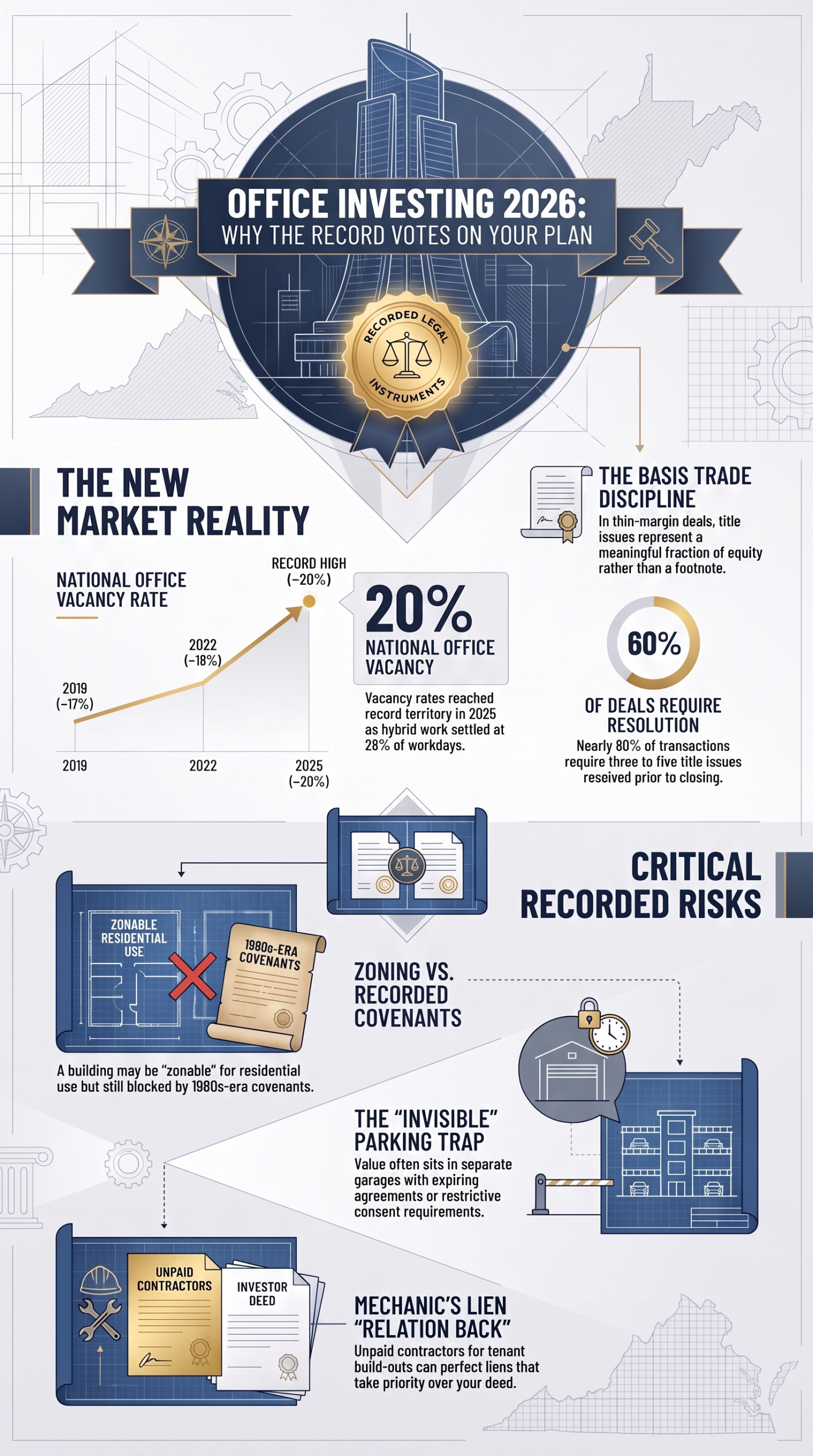
Hybrid work settled at about 28 percent of paid workdays and never went back, national office vacancy set records near 20 percent, and values followed. That is exactly why the record matters more now, not less: at a thin basis, a stranded parking allocation, a recorded tenant option, or a covenant against conversion is no longer a footnote. It is a meaningful fraction of your equity.
This guide walks through the lease stack, estoppels, parking and garage agreements, shared facilities, office condominiums, conversion restrictions, liens, debt, entities, and the closing itself in Virginia and West Virginia, and how my team clears each one. Every figure is attributed to its source, with the full list at the end. This is general educational information, not legal, tax, lending, zoning, or regulatory advice for any specific transaction.
I wrote this because office is the asset class where the gap between the price and the plan is widest right now, and the record is what fills that gap, in your favor or against you. My lane is the recorded layer, the escrow, and the closing, and I run that lane end to end. Leasing strategy, conversion feasibility, building systems, and market underwriting belong to your brokers, architects, engineers, and counsel, and I coordinate with them rather than stand in for them. Where the record does not answer a question, I say so, and I point it to the right professional.
You are buying a plan, and the record votes on it
Nobody buys an office building in 2026 to keep doing what it was doing in 2019. The purchase thesis is always a change: re-lease the vacancy at a new price point, reposition the building for smaller tenants, add amenities, or convert it out of office entirely. The price you negotiated reflects that plan. What the price cannot tell you is whether the building is legally able to execute it, because the answer lives in a stack of recorded instruments most buyers have never read: the garage agreement that allocates the parking, the reciprocal easements that share the plaza and the loading dock, the condominium declaration that fixes the unit boundaries, the recorded tenant memoranda that carry options and refusal rights, and the covenants recorded when the building was something else’s idea.
Here is the math that makes this guide worth your time. When office traded at peak prices, a recorded problem worth a few hundred thousand dollars was an annoyance inside a wide margin. At a repriced basis, that same problem is a meaningful fraction of your equity, and a problem that blocks the plan, a covenant against residential use, an option that removes your best floor, a parking allocation that expires, is not a fraction of anything. It is the deal. So my thesis for office is the sharpest version of the one I bring to data centers, industrial, and multifamily: the thinner the margin, the harder the record has to be read. That discipline is built into my office acquisition service, and this guide is the long-form version of it.
The market you are buying into
Two numbers explain the entire office market, and both have stopped moving. WFH Research, which has tracked working arrangements continuously since the pandemic, puts the share of United States paid workdays worked from home at about 28 percent, a level that has held rather than faded. Demand repriced to that reality: Moody’s data shows national office vacancy climbing from roughly 17 percent in 2019 to about 19 percent in 2022 and on to record territory around 20 percent in 2025. Hybrid stuck, vacancy set records, and values followed.
None of that is a reason to stay away. It is the reason the current buyers exist: repriced office is a basis trade, and basis trades reward the operators who underwrite carefully and punish the ones who do not. The land title industry’s own numbers say where the punishment hides: the American Land Title Association reports that nearly 60 percent of transactions need three to five title issues resolved before closing. On a wide-margin deal those issues are friction. On a thin-margin deal they are the underwriting. The rest of this guide is the office-specific list.
The lease stack: fewer tenants, bigger rights
An office rent roll is the inverse of an apartment rent roll, and the inversion changes the risk. An apartment community spreads its income across hundreds of small, largely identical tenancies, so no single lease can sink the deal. An office building concentrates its income in a handful of tenants, and the large ones negotiated for more than space: options to extend, options to expand into adjacent floors, rights of first refusal on space or on the building itself, termination rights tied to dates or events, and exclusive-use protections. In an apartment community, no single lease can sink the deal. In an office building, one recorded memorandum can.
The record is where those rights become dangerous, because office tenants large enough to negotiate them are large enough to record them. A memorandum of lease recorded years ago can carry an expansion right over the exact floors your repositioning plan needs, or a right of first refusal that turns your signed contract into someone else’s opportunity. Those instruments bind you from the moment the deed records, whether or not the seller’s lease abstract mentioned them, and they do not expire just because the market did.
How we help: I pull every recorded lease, memorandum, option, and refusal right in the chain, date them, map them against the rent roll and the floors your plan touches, and put the collisions in front of you and your counsel inside the diligence period. A tenant right discovered at the letter of intent is a negotiation. The same right discovered after the deed records is your new business partner.
Estoppels and SNDAs when every tenant is material
On an office file the estoppel package is short and heavy. Ten signatures instead of four hundred, but every one of them is material, and the anchor tenant’s certificate is practically a closing condition of its own. The estoppel is where the lease file and reality get reconciled in writing: the rent, the term, the options, the unpaid improvement allowances and outstanding landlord obligations, the defaults nobody mentioned. On repriced buildings the landlord-obligation line deserves particular attention, because deferred allowances and unfinished build-outs are exactly the liabilities a stressed seller stops funding.
Subordination and non-disturbance agreements travel with the estoppels, and in office they cut both ways. Your lender wants the leases subordinated to its deed of trust. Your anchor tenants, the income the whole basis rests on, want non-disturbance in return, and their leases often entitle them to it. Sequencing that exchange late is how closings slip, because the SNDA negotiation involves three parties who each move on their own clock.
How we help: we build the estoppel and SNDA list at the front of the file, tenant by tenant against the lender’s requirements, coordinate the circulation, reconcile every certificate against the rent roll and the recorded instruments from the last chapter, and confirm the package through the escrow before funding. The surprises surface while they still have prices attached.
Parking: the value may sit in someone else’s garage
Office value assumes parking the way it assumes elevators, and the assumption is frequently wrong in an instructive way: the parking is real, but it is not yours. Urban and suburban towers alike routinely park in a structure on a separate parcel, owned by a different entity, under a recorded parking agreement or easement with its own allocation of spaces, its own term, its own rates, and its own assignment rules. The building and its parking can be married by a document that is decades old, and the document, not the habit, is what you are buying.
The failure modes are specific. An allocation sized for the seller’s tenancy rather than running with the land. A term that expires inside your hold period. Rates that reset. A consent requirement that makes your purchase itself an assignment needing the garage owner’s signature. Or nothing recorded at all, just an arrangement between two owners who got along, which is a description of a problem, not a right. Zoning ratios and your lender’s underwriting both assume the spaces, so a defect here reaches the whole capital stack.
How we help: I pull the full recorded parking set, confirm the rights actually serve your parcel and survive the sale, flag every consent, expiration, and reset, and reconcile the recorded allocation against the count your plan and your lender assume. If the building’s parking is a handshake, you will know inside the diligence period, while a recorded agreement is still something the seller can help you get.
Reciprocal easements and the shared spine of the block
Office buildings rarely stand alone, even when they look like they do. Two towers share a plaza, a loading dock, a chiller plant, a parking structure, an amenity floor. A mixed-use block shares everything. The instrument that holds it together is usually a reciprocal easement agreement or a set of cross-easements and declarations, recorded against every parcel they touch, and they are among the densest documents in commercial real estate: rights and obligations, cost-sharing formulas, maintenance standards, approval rights over alterations, insurance requirements, and sometimes consent rights over transfers.
You inherit the whole arrangement at closing, the benefits and the burdens alike, and the burdens are the part the broker package omits. A cost-sharing formula written when both towers were full can allocate expenses in ways that sting when one of them is not. An approval right held by the neighboring owner can reach into your renovation plan. And because these instruments were drafted for the block’s original life, they interact directly with the conversion question two chapters from now: an agreement that shares a garage by office headcount has opinions about your residential conversion.
How we help: I read the reciprocal easement set in full, verify each arrangement against the ALTA survey, extract the obligations, formulas, approval rights, and consents into plain language, and flag the provisions that touch your plan. The goal is that you know what the block requires of the building before the building is yours.
The office condominium: buying a unit, not a building
Some office buildings are not one property at all. They are condominiums, split into units by a recorded declaration, and what you are buying is a unit plus an undivided share of the common elements, on the declaration’s terms. Virginia governs these regimes under the Virginia Condominium Act, Title 55.1, Chapter 19 of the Code, and West Virginia under its Uniform Common Interest Ownership Act, Chapter 36B. The declaration, the plats, and the amendments are the property: they fix the unit boundaries, define what is common and what is yours, set the assessments, and often restrict what a unit may be used for.
The office condominium changes your diligence in kind, not just degree. The unit boundary is a legal line, frequently the interior surfaces, and the space you toured has to match the unit the plats describe. The association is a counterparty with a budget, reserves, pending assessments, and possibly litigation, all of which you inherit an interest in. Use restrictions in the declaration can bind harder than zoning, and amendment usually requires votes you do not control. A repositioning plan that needs a declaration amendment is a plan with partners.
How we help: we review the declaration, plats, bylaws, and every amendment, confirm the unit you are buying matches the space you priced, obtain the association’s estoppel on assessments and violations, and flag the use restrictions and approval rights that touch your plan. Buying a unit is buying a governance structure, and the governance is in the record.
Repositioning and conversion: what the record allows
Conversion is the loudest strategy in office, and it is where every chapter of this guide converges at once. A plan to take a building out of office use, to residential, to lab, to storage, to a school, tests the whole recorded stack simultaneously: covenants recorded by the original developer that limit use, reciprocal easement agreements whose formulas and rights assume office occupancy, condominium declarations that fix unit use, parking agreements allocated by office tenancy, and recorded tenant rights over the very floors the plan would empty. Zoning gets the headlines, but a building can be perfectly zonable for residential and still be blocked by a covenant from 1987.
My lane discipline matters most here, so let me state it precisely. The approvals, the rezoning or special exception, the building code path, the feasibility of the floor plates, belong to your land use counsel, your architects, and the county, and I do not stand in for any of them. What I contribute is the complete recorded picture they build on: every covenant, condition, easement, declaration, and tenant right that has a vote on the plan, surfaced and dated inside the diligence period. The most expensive sentence in a conversion is we did not know that was recorded.
How we help: on a conversion or repositioning file we run the record against the plan, not just against the sale. Every instrument gets read with one question in mind, does this document care what the building is used for, and everything that answers yes goes on one list for you, your counsel, and your lender, while the diligence period is still open and the price can still move.
Tenant build-outs and invisible lien exposure
Office buildings generate construction continuously even when nothing looks under construction, because re-leasing is building: every new lease brings a tenant build-out, every renewal brings an allowance, and a repositioning brings contractors to half the floors at once. In Virginia, that matters at closing because a mechanic’s lien under Title 43 relates back to when the work began, not when the claim is filed, so a contractor unpaid for last quarter’s build-out can perfect a lien after your deed records, with priority that steps in front of it. West Virginia’s framework under Chapter 38, Article 2 of its code carries the same essential threat, and the mechanics are the ones I walk through in the industrial construction lien deep dive.
Office adds a twist: much of the work is commissioned by tenants, not the owner, and depending on the facts a tenant’s unpaid contractor can still reach the building. The question the title search cannot answer is the one that matters: what work happened in the lien window, who ordered it, and who has been paid. How we help: we ask exactly that, collect lien waivers and contractor affidavits through the escrow, reconcile the seller’s allowance obligations from the estoppels against the construction actually performed, and where real exposure remains, hold funds in escrow until the window closes or the releases arrive.
Payoff, assumption, or consent: the loan meets the new price
Office debt is where the repricing gets personal, because the loan on the building was usually sized for the old value. The existing debt takes one of three paths through your closing: paid off and released, assumed with the lender’s approval, or left in place with consent to the transaction. Each path has its own clock and checklist, and on repriced office the payoff path has a version the other asset classes rarely see: sales that close near, at, or below the debt, where the payoff figures, the release mechanics, and sometimes a negotiated resolution with the lender are the whole closing. In those files the release is not paperwork at the end. It is the deal, and every figure has to be in writing before funds move.
Prepayment economics and assumption terms belong in your model early, alongside the plan: a loan worth assuming for its rate may carry covenants written against the very repositioning you bought the building to do. That analysis belongs to you and your debt advisors; what belongs to me is the landing. How we help: we obtain payoff and release requirements in writing directly from the holder, or run the assumption and consent checklist on the lender’s timeline, track every deliverable to the closing date, and sequence the funding so the release, the deed, and the new deed of trust record in the right order, whatever the price did to the balance.
Entities, funds, exchanges, and foreign sellers
Office buyers close through structures: a single-purpose entity under a fund, a joint venture between capital and an operator, tenants in common completing an exchange, an institution entering through a subsidiary nobody at the table has met. Every layer adds documents the closing needs, formation records, resolutions, consents, incumbency, and a signature block that actually binds the signer, and authority defects surface at the worst possible moment because nobody looks for them until the notary is waiting. On the sell side, distressed and transitional office adds its own cast: special servicers, receivers, and lenders selling what they took back, each with authority documents of their own that deserve the same scrutiny.
Two federal layers ride along. A 1031 exchange puts absolute identification and closing deadlines on the file, and the escrow has to be built around them from day one. And if any seller in the chain is a foreign person, federal law generally requires withholding a portion of the price at the settlement table under the Foreign Investment in Real Property Tax Act, a real obligation with real liability. How we help: we collect and verify entity and authority documents at the contract stage, on both sides of the table, coordinate exchange mechanics with your intermediary, screen for withholding, and match every signature block to the structure chart before signing day.
Virginia and West Virginia, side by side
The two states agree on the fundamentals that fill this guide: recorded instruments bind the buyer in both, mechanic’s liens relate back in both, and condominium regimes live in a recorded declaration in both, under the Virginia Condominium Act on one side of the border and West Virginia’s Uniform Common Interest Ownership Act on the other. The differences concentrate at the closing table, and they are worth knowing before you model a deal across the line.
Virginia is a settlement-agent state: licensed settlement agents, including attorney-led firms like mine, conduct closings, and the taxes stack with the buyer carrying the recordation and deed of trust taxes while the seller carries the grantor’s tax plus regional fees in Northern Virginia. West Virginia treats the closing itself as attorney work: the West Virginia State Bar’s unauthorized practice guidance, Committee Opinion No. 2003-01, places title examination and the conduct of the closing with a licensed West Virginia attorney, so West Virginia counsel belongs on the team from the first week. West Virginia’s transfer excise under Code Section 11-22-2 falls on the seller by default, and the state imposes no value-based tax on recording your deed or your deed of trust, which favors financed buyers. How we help: my firm runs attorney-led files by design, so the West Virginia posture is native to us, and cross-border files run through one open-items list rather than two parallel processes.
The closing: what recording the deed costs at a 2026 basis
Here is the closing-week math on a $10,000,000 office purchase, sourced line by line, with one observation the other guides do not need: at a repriced basis, these lines are a larger share of the equity than they were at the old prices, so they belong in the underwriting rather than the footnotes. In Virginia, the buyer pays the state recordation tax of $0.25 per $100 under Code Section 58.1-801 plus the local third under 58.1-814, about $33,300 together, and a financed buyer adds the deed of trust recordation tax under 58.1-803, $0.25 per $100 on the first $10,000,000 of debt, $25,000 of state tax alone before the local third. Call the buyer’s side roughly $58,300 before the local add-on on the deed of trust: noise at a 2019 price, real money at a 2026 basis. The seller pays the grantor’s tax of $0.50 per $500 under 58.1-802, $10,000 here, plus the WMATA Capital Fee under 58.1-802.3 and the Regional Congestion Relief Fee under 58.1-802.4 in the Northern Virginia jurisdictions, $30,000 in all.
In West Virginia the architecture inverts. The transfer excise under West Virginia Code Section 11-22-2 falls on the seller by default and runs from $33,000 at the floor to $55,000 at the maximum county rate on a $10,000,000 conveyance, while the buyer records the deed and the deed of trust for flat fees with no value-based tax. Every allocation is negotiable by contract, so treat the statutory defaults as the opening position, particularly on distressed sales where the seller’s side of the ledger is already spoken for.
One more line belongs in the model on office specifically: prorations of operating costs under the reciprocal easement agreements and condominium assessments from earlier chapters. Those formulas do not pause for your closing, and a settlement statement that reconciles them against the actual instruments, rather than the seller’s estimate, is cheaper than the argument afterward.
Wire fraud on an office closing
An office closing concentrates everything the wire fraud data warns about: a large purchase wire, a payoff wire that may be the largest number on the file, several entities, several advisors, and a long email chain connecting them under deadline pressure. The Federal Bureau of Investigation’s Internet Crime Complaint Center has tracked tens of billions of dollars in business email compromise losses, and the land title industry’s own figures put an attempted wire fraud on roughly one in three real estate transactions, with average losses of $150,000 to $200,000 and commercial deals running higher.
The defense is process without exceptions. Wire instructions are established at the opening of the file and verified by phone with known contacts. No change to payment instructions is ever accepted by email, whatever the urgency and whoever the signature block claims to be. Funds disburse only when written closing conditions are met, and on payoff-critical files the payoff instructions get the same verification the purchase wire does. How we help: those rules are how my escrow runs on every file, and at these amounts they are the difference between a closing and a company-altering loss.
Challenges, and how we clear them
Six issues account for most of the friction on office files, and each one has appeared in this guide. Parking and garage agreements: we pull the recorded set and confirm the rights serve the building and survive the sale. Shared facilities and cross-easements: we verify each recorded arrangement against the ALTA survey and extract the obligations and consents it carries. Condominium structures: we review the declaration, plats, and amendments, and confirm the unit you are buying matches the space you toured. Tenant rights that outlast the plan: we surface recorded options, expansion rights, and refusal rights early, so the plan is tested against the record inside the diligence period. Restrictions against conversion: we surface every recorded covenant and condition, and the approvals run through your land use counsel and the county. Recent build-out work: we investigate the lien window, collect waivers, and escrow where exposure remains.
The pattern across all six is the same, and it is the thesis of this guide: office is a plan wrapped in a building, and the record votes on the plan. Getting the record, the money, and the paperwork to land together is the job, and it is why the file runs through attorneys. The broader framework, if you want it, is on my page explaining what a title and escrow company does, and if you are on the other side of one of these deals, the disposition version lives on my office selling page.
Send me the contract or the letter of intent, the shared facility and garage agreements if you have them, the financing timeline, and the diligence deadlines, and my team will open the file, order the title and survey, and test the record against your plan from day one.
Get Your Free Quoteor call (703) 552-4155This guide pairs with my office title and settlement service and its disposition counterpart for office sellers. The sibling guides cover the other asset classes in depth:
The data center buyer’s guide • The industrial buyer’s guide • The multifamily buyer’s guide
We close across Virginia and West Virginia, with deep experience in the office markets where these buildings trade:
Northern Virginia: Arlington County, Alexandria, Fairfax County, and Loudoun County.
Richmond metro: Richmond, Henrico County, and Chesterfield County.
Hampton Roads: Norfolk, Virginia Beach, and Hampton.
Questions office buyers ask me
The building is an office condominium. What actually changes at closing?
You are buying a unit and a share of the common elements, on the recorded declaration’s terms, under the Virginia Condominium Act or West Virginia’s Uniform Common Interest Ownership Act depending on the state. The unit boundary is a legal line fixed by the plats, so the space you toured has to match the unit described. The association becomes your counterparty, with assessments, reserves, and use restrictions you inherit, so we review the declaration and every amendment, obtain the association’s estoppel, and flag anything that touches your plan before diligence ends.
The parking sits in a separate garage. Is that a problem?
Only if the paper is. Separate-parcel parking is normal for office, and it works when a recorded agreement or easement allocates the spaces to your parcel, runs with the land, and survives the sale on terms your plan and your lender can live with. It becomes a problem when the allocation is personal to the seller, the term expires inside your hold period, the rates reset, your purchase requires the garage owner’s consent, or nothing is recorded at all. We pull the full recorded set and answer exactly that inside the diligence period.
We are underwriting a conversion. What does title contribute?
The complete recorded picture the plan gets tested against. Zoning approval runs through your land use counsel and the county, but a building can be zonable for the new use and still blocked by the record: a use covenant from the original development, a reciprocal easement whose formulas assume office occupancy, a condominium declaration that fixes unit use, or a recorded tenant right over the floors the plan would empty. We surface every instrument that has a vote on the conversion, dated and in plain language, while the diligence period is open and the price can still move.
Sources
Every figure in this guide is drawn from the sources below, current as of the dates shown. Where a source did not provide a figure, I have left it out rather than estimate.
WFH Research, Survey of Working Arrangements and Attitudes (share of United States paid workdays worked from home). https://wfhresearch.com/
Moody’s, national office vacancy data, 2019 to 2025, as cited on my office service page. https://cre.moodysanalytics.com/
Code of Virginia, Title 55.1, Chapter 19, Virginia Condominium Act. https://law.lis.virginia.gov/vacodefull/title55.1/chapter19/
West Virginia Code, Chapter 36B, Uniform Common Interest Ownership Act. https://code.wvlegislature.gov/36B-1/
Code of Virginia, Title 58.1, Chapter 8, State Recordation Tax, §§ 58.1-801 through 58.1-814. https://law.lis.virginia.gov/vacodefull/title58.1/chapter8/
West Virginia Code, § 11-22-2, Excise tax on privilege of transferring real property. https://code.wvlegislature.gov/11-22-2/
Code of Virginia, Title 43, Mechanics’ and Materialmen’s Liens. https://law.lis.virginia.gov/vacodefull/title43/
West Virginia Code, Chapter 38, Article 2, Mechanics’ liens. https://code.wvlegislature.gov/38-2/
West Virginia State Bar, Committee Opinion No. 2003-01 (unauthorized practice of law; real estate settlement services). https://wvbar.org/wp-content/uploads/2012/04/AO-2003-01.pdf
Internal Revenue Service. Reporting and paying tax on U.S. real property interests (FIRPTA). https://www.irs.gov/individuals/international-taxpayers/reporting-and-paying-tax-on-us-real-property-interests
American Land Title Association, industry data cited in text (risk cleared annually; share of transactions requiring title issue resolution; wire fraud attempt and loss figures, with Stewart). https://www.alta.org/
Federal Bureau of Investigation, Internet Crime Complaint Center. Business email compromise: The $50 billion scam. https://www.ic3.gov/PSA/2023/PSA230609
This guide provides general educational information for Virginia and West Virginia and is not legal, tax, lending, zoning, land use, condominium, or regulatory advice for any specific transaction. Every acquisition requires review of its own property, documents, parties, leases, and title-insurance terms. Data and legal frameworks are attributed to third-party sources and reflect the dates those sources describe, and both continue to change. Please confirm anything you intend to rely on, and reach out to me directly with questions about your own acquisition.