

The rent roll sells the center. The record closes it. A retail buyer prices your income first and then reads everything it sits on: the reciprocal easement agreements, the recorded exclusives, the anchor rights and rights of first refusal, the outparcel obligations, and every lien that constant build-out work left behind. In my buyer’s guide I told the other side of this table that a shopping center is a set of recorded agreements wearing a building. This guide is for the person selling the agreements: how to hand the buyer a clean stack, keep the price defensible, get the anchor’s waiver signed on schedule, and land the proceeds exactly where they belong.
Written by Anthony I. Shin, Esq., Principal and real estate attorney at Prime Title & Escrow
The rent roll sells the center, the record closes it, and every recorded surprise the buyer finds gets translated into a capitalization rate argument you fund.
Retail did not die. It got picky, and so did your buyer: about 84 percent of United States retail sales still happen in person per the Census Bureau, well-located centers keep trading, and the buyers doing the trading read the record hard. What they will read on your center is specific: the reciprocal easement agreements that run it, exclusives that may conflict with each other, anchor rights that can reach the sale itself, a common area maintenance reconciliation that is always in progress, and the liens a decade of tenant turnover left behind.
This guide answers the questions retail sellers actually ask, in order: the reciprocal easement agreement, the exclusives, the anchor rights, the estoppels, the CAM and percentage rent, the outparcels, the releases, the loan, the exchange decision, the two states, the money, and the proceeds. Every figure is attributed to its source, with the full list at the end. This is general educational information, not legal, tax, lending, leasing, or regulatory advice for any specific transaction.
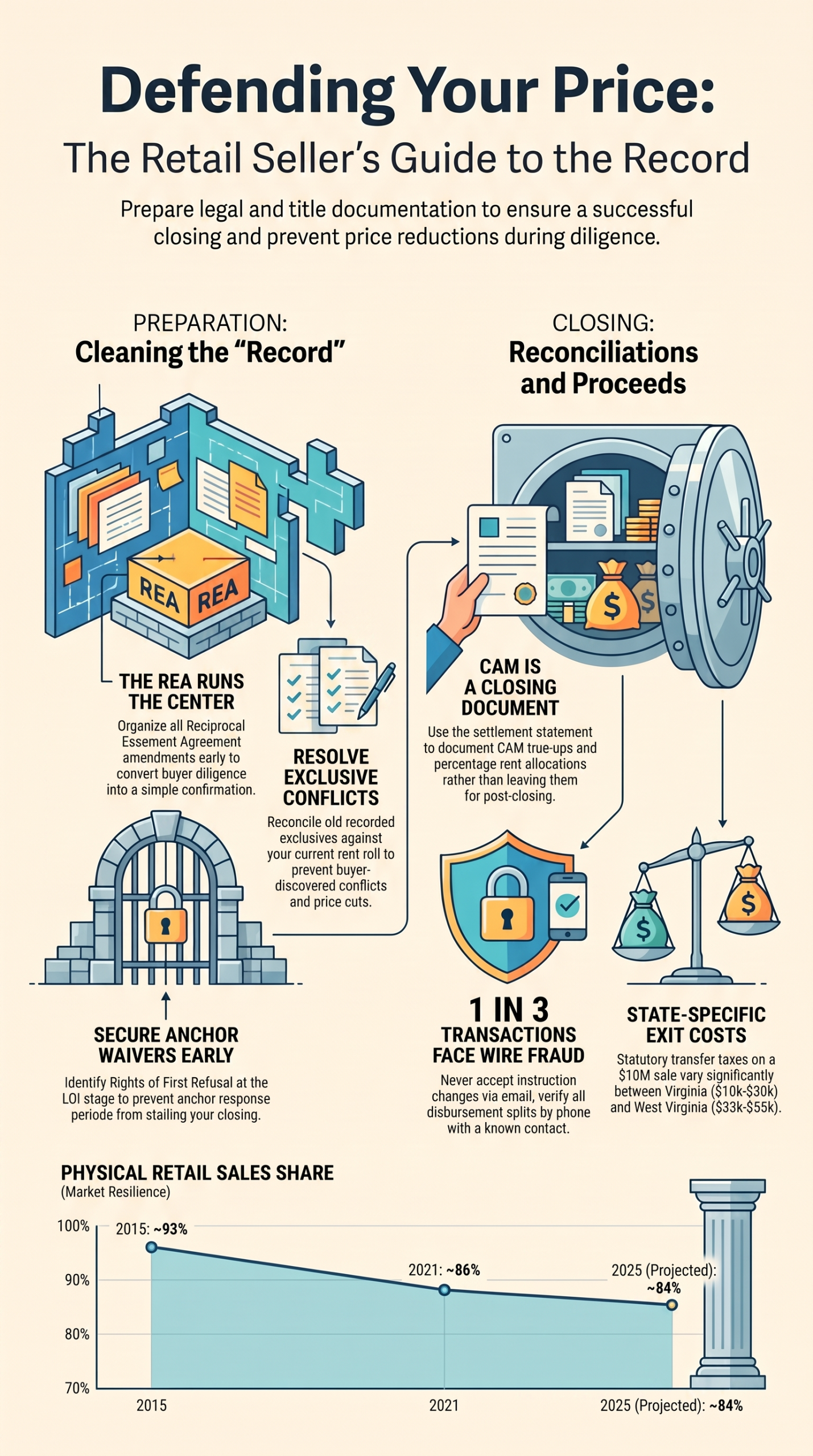
I wrote this because retail sellers hold the most heavily papered asset in commercial real estate, and most of the paper was written by previous owners, previous anchors, and previous decades. My retail buyer’s guide shows you exactly what the other side will read. This one is your side of the table, the record, the estoppels, the reconciliations, the payoffs, the escrow, and the disbursement, run end to end. Leasing and merchandising are the buyer’s bet, pricing belongs to you and your broker, and the decisions inside your ownership belong to you and your counsel. Where the record does not answer a question, I say so, and I point it to the right professional.
Why does the record decide what a retail buyer will pay?
Because the rent roll tells the buyer what the center earns, and the record tells them whether it can keep earning it, and no asset class wires those two documents together more tightly than retail. Every tenant on your rent roll occupies a position inside a recorded system: parked on the shared field the reciprocal easement agreement governs, protected or constrained by the exclusives, visible on a pylon whose panels are allocated by instrument, and neighbored by an anchor whose recorded rights may reach further than anyone remembers. When the rent roll and the record agree, diligence confirms and the deal accelerates. When they differ, the difference comes out of your price, one objection letter at a time.
Everything the buyer will find is findable now, by you, at a moment when finding it is cheap. The seller who pulls the record at the letter of intent hands the buyer’s team a clean stack, answers from documents, keeps the diligence clock from spending the price, and walks into the contract knowing exactly what the permitted exceptions should say. That is the discipline behind my retail disposition service, and this guide is the long-form version of it.
What is the retail market telling sellers?
That the sector’s obituary was wrong, and that the surviving buyers read everything. United States Census Bureau data puts about 84 percent of retail sales in physical channels, in person, in stores, on real dirt, and the decade arc shows the erosion slowing: from about 93 percent physical in 2015 to about 86 percent in 2021 to about 84 percent in 2025. Retail did not die. It got picky, and what held was built around daily needs, which is why well-located, grocery-anchored, and necessity-driven centers keep trading while the buyers doing the trading underwrite the record as hard as the rent roll.
Picky buyers are a prepared seller’s best audience, because they pay for certainty and discount everything else. The American Land Title Association reports that nearly 60 percent of transactions need three to five title issues resolved before closing, which is the market rate for unpreparedness. On a retail file, where a title issue is usually a leasing issue wearing a recording stamp, the seller who resolves the record in advance is selling the one thing this market cannot manufacture: a center whose income and instruments already agree with each other.
What will the buyer ask about our reciprocal easement agreement?
Everything, because the reciprocal easement agreement runs the center, and the buyer’s team will read every page. The REA governs the parking and the access, allocates the maintenance and its costs, fixes building areas, restricts uses, and often gives one or more parties, the anchor above all, approval rights over changes, and when the anchor owns its own pad, the REA is the only contract between the center and its most important business. The buyer will ask for the complete recorded set, the original plus every amendment and supplement, and they will ask whether anyone is in default under it, which is a question best answered by an estoppel from the REA parties rather than by your recollection.
The sell-side move is to hand them a clean stack before they assemble a messy one. Forty years of amendments can move obligations in ways the original document never imagined, and an REA set the seller organized, with the cost formulas current, the consent provisions flagged, and the party estoppels in motion, converts the buyer’s biggest reading assignment into a confirmation exercise. How we help: we pull the full recorded REA set at the letter of intent, extract the obligations, allocations, and consent requirements into plain language, coordinate the REA-party estoppels alongside the tenant estoppels, and put the whole picture in front of your counsel and the buyer’s team before they ask.
The buyer found a recorded exclusive from an old lease. Is the sale in trouble?
Usually not, but the exclusive controls the conversation, and the first person it surprises should be you. An exclusive is a promise made to one tenant that every other doorway in the center has to keep, and centers accumulate them the way they accumulate tenants: the grocer’s no-other-food-store, the pizza shop’s no-other-pizza, the salon’s radius clause, recorded through memoranda, hidden in declarations, and sometimes living only in the leases themselves. Some expired by their own terms years ago, and the instrument proves it. Some are alive and simply need disclosing, because they are facts about the center the buyer will price either way. The dangerous ones are the conflicts.
Exclusives recorded over the years can conflict with each other, and occasionally with your own current rent roll, which means a center can be quietly violating a promise it made in 1998 to a tenant that left in 2009 whose exclusive never left with it, or leasing today against a restriction nobody read since the memorandum recorded. Discovered by you, a conflict is a curative project or a disclosure with a plan attached. Discovered by the buyer, it is a retrade with an instrument number on it. How we help: we surface every recorded exclusive and use restriction early, from the memoranda, the declarations, and the REA set alike, reconcile the list against your rent roll, and put the same picture in front of your counsel and the buyer’s team on your schedule, not theirs.
Can the anchor’s right of first refusal stop our sale?
Usually not, but it owns the calendar, and until the waiver is signed, your contract may be someone else’s option. Anchors negotiate like anchors, and what they negotiate gets recorded: options to extend for decades, rights of first refusal or first offer, purchase options on their own pads, approval rights over changes, and sometimes rights that reach your transaction directly, a refusal right on a sale of the center or an approval right over who the buyer may be. A recorded refusal right means the anchor gets notice of your deal on the terms the instrument specifies and a defined period to match it, and nothing compresses that period because your buyer’s financing is ready or your exchange clock is running.
Sequencing is the entire game. Notice given at the letter of intent produces a waiver or a decision on schedule, resolved before the diligence period even matures. Notice remembered in closing week produces a fire drill with the deal itself exposed, because a sale closed over an unwaived refusal right is a problem that outlives the closing. How we help: we identify every recorded anchor right at the front of the file, calendar the notice and response periods against the contract, and track the notices, waivers, and consents through the escrow, so nothing surfaces at the deadline and the waiver is a signed artifact before anyone schedules a closing.
Do we need estoppels from every tenant in the center?
No, but you need the right ones, and the anchor’s is functionally a closing condition. Retail estoppel packages span the widest range in commercial real estate, from a national anchor with a legal department to a one-location restaurant signing between lunch rushes, so the workable structure is negotiated at signing: certificates from the anchor and an agreed share of the shops, thresholds the buyer’s lender sets, and a seller’s certificate standing in where the contract allows it. Retail certificates also do double duty, confirming not just rent and term but the health of the system: co-tenancy claims, percentage rent status, disputed common area charges, and unfinished landlord work.
What comes back is the quiet risk, because a certificate that contradicts the rent roll is a retrade with a signature on it, and every discrepancy, the concession, the disputed reconciliation, the option nobody flagged, is better reconciled by you before the buyer reads it. How we help: we build the estoppel tracking list from the rent roll against the contract’s and the lender’s requirements, coordinate collection with your manager, reconcile every certificate against the file and the recorded exclusives, and confirm delivery through the escrow before funding, so the lender funds on a complete package and you never chase signatures in closing week.
How are CAM charges and percentage rent handled at closing?
As closing documents, because at any retail closing there is a common area maintenance reconciliation in progress. All year you collect estimated CAM charges from the tenants while the actual costs accrue, and the true-up happens afterward, which means your sale interrupts the cycle mid-stream: money collected but not yet reconciled, costs incurred but not yet billed, and a buyer who will inherit the argument unless the settlement statement settles it. Percentage rent runs on the same logic, accruing across a lease year the sale will cut in two, with sales reports that arrive after your deed records.
The fix is arithmetic stated in words. The contract should say how CAM estimates and actuals prorate, who conducts the true-up, and when, and how percentage rent for the broken year gets allocated and paid, and the settlement statement should carry each mechanism as a documented line rather than a handshake. How we help: we bring the CAM reconciliation and the percentage rent allocation onto the statement exactly the way the contract says, documented to the day, so the buyer’s day one is clean and your file is closed instead of arguing by email in March.
What if we are selling the center but keeping a pad?
Then the deed you sign for the center writes the future of the pad you keep, and it has to say so expressly. A retained outparcel lives or dies on recorded rights across the property you are selling: access over the drives, parking on the shared field, drainage into the stormwater system, a panel on the pylon, and a share of the maintenance at a stated cost allocation. If those rights exist only in the current common ownership, they vanish the day the deed records without them, and you will have done to your own pad what this whole series warns buyers about: created a parcel whose access is a habit. The same discipline runs in reverse when you sell a pad and keep the center, because the cost-sharing allocations have to be reworked so they still add up after the split.
Partial retail sales add two more layers: the legal descriptions at the new seam have to be exact, survey-tied, and gap-free, and any outparcel rights of first refusal in the record may reach the transaction, with notice clocks of their own. How we help: we draft and record the reservations that protect what you keep, coordinate the description work with your surveyor, rework the recorded cost allocations so the arithmetic survives the split, and run any refusal notices through the escrow on schedule, so a partial sale closes as cleanly as a whole one.
Why are there liens on the title for build-outs we already paid for?
Because paying a contractor does not update the record. Only a recorded release does, and retail generates more small construction than any other asset class: a build-out on every new lease, facade programs when the center refreshes, pad construction at the edges, parking and roof work on the cycle. Every project left contractors, and sometimes their financing, in contact with your record, and after years of tenant turnover the title search reads like a scrapbook: mechanic’s liens from disputes settled long ago, deeds of trust from improvement loans retired years back, financing statements that outlived their equipment. In Virginia a mechanic’s lien under Title 43 relates back to when the work began, and West Virginia’s Chapter 38, Article 2 framework carries the same essential threat for recent work.
The buyer’s title company cannot insure over what the record still shows, so every ghost becomes a commitment requirement, and chasing a release from a contractor who retired or a lender that merged twice is a project measured in weeks. Retail adds the allowance wrinkle: tenant-ordered work funded by landlord allowances blurs who owes whom, and unfunded allowance obligations surface in the estoppels while the lien exposure surfaces in the title, so the two lists have to be reconciled against each other. How we help: we identify every unreleased instrument in the first title run, open the chase immediately, reconcile the allowance obligations against the construction actually performed, prepare curative documents where the original holder is gone, and track each release to recording while the deal is still young.
What happens to our loan: payoff, assumption, or release?
One of three things: it gets paid off and released, assumed by your buyer with the lender’s approval, or partially released if the debt blankets more than you are selling, and on centers financed through securitized loans, the servicer’s process sets the calendar and bends for no contract date. Each path has its own checklist, fees, and clock. The loan documents were underwritten to the center’s system, so assignments of the REA rights, the exclusives, and the anchor lease travel with the deed of trust, and the release has to unwind all of it cleanly, in the right recording order, on the day you sell.
Prepayment economics, yield maintenance, defeasance, and whether an assumable below-market loan is part of your price belong to you and your debt advisors. What belongs to me is the landing. How we help: we obtain payoff letters, per-diem figures, and release requirements in writing from every holder or servicer in the stack, obtain partial-release terms wherever debt crosses property you are keeping, build the figures into the settlement statement to the day, and sequence the funding so the releases, the deed, and the buyer’s financing record in the right order.
Do we have to do a 1031 exchange when we sell?
No. Divesting is a decision about the money’s next job, and there are three honest versions of it. Some sellers exchange into more real estate, and retail sellers exchange constantly, on the statute’s unforgiving clock: 45 days from your closing to identify replacement property and 180 days to close on it, both measured from the day your deed records, with no extensions. Some owners exchange into passive replacement structures so the capital stays in real estate while the management stops, a choice that belongs entirely to your tax and investment advisors. And some sellers pay the tax on purpose, because the whole point of the sale was to be done. Paying the tax on purpose is a plan. Paying it by accident, because nobody put the intermediary in place before closing, is a mistake, and it is permanent.
The mechanics have one non-negotiable: an exchange exists before closing or not at all. The qualified intermediary must be assigned into the transaction and the proceeds must flow directly from settlement to the intermediary, because a seller who touches the money, even briefly, can collapse the treatment entirely, and an anchor’s refusal-right clock from chapter five has to be built into the exchange calendar rather than discovered inside it. How we help: we coordinate with your intermediary from the day you tell us an exchange is in play, build the assignment and disbursement mechanics into the closing, and protect the deadlines the way we protect the money, because for an exchange seller they are the same thing.
How do Virginia and West Virginia treat a retail seller differently?
At exactly two points: who conducts the closing, and who pays the transfer taxes. Everything else in this guide crosses the border intact, because reciprocal easement agreements, exclusives, anchor rights, and releases are creatures of the recorded instrument rather than the statute, and they bind a seller identically on both sides of the line. On the tax point, the seller’s chair reverses which state looks friendly.
In Virginia, the seller’s statutory share is light: the grantor’s tax of $0.50 per $500 under Code Section 58.1-802, plus the WMATA Capital Fee under 58.1-802.3 and the Regional Congestion Relief Fee under 58.1-802.4 in the Northern Virginia jurisdictions, while the buyer carries the recordation stack. In West Virginia the default inverts onto you: the transfer excise under Code Section 11-22-2 falls on the grantor, $33,000 at the floor to $55,000 at the maximum county rate on a $10,000,000 sale, while the buyer records for flat fees. Allocation is negotiable in both states, and a West Virginia seller should walk in knowing the default is theirs. The closing itself follows the pattern of this whole series: Virginia runs through licensed settlement agents, including attorney-led firms like mine, while the West Virginia State Bar’s unauthorized practice guidance, Committee Opinion No. 2003-01, treats title examination and the conduct of the closing as attorney work, so West Virginia counsel joins the team in week one. How we help: my firm is attorney-led by design, so both postures are native to us, and a portfolio that straddles the line runs through one open-items list.
What does it cost to sell a $10,000,000 shopping center?
Between $10,000 and $55,000 in transfer taxes alone, depending on the state and the county, before the payoffs, releases, and reconciliations. A Virginia seller outside Northern Virginia owes the grantor’s tax alone, $10,000 at $0.50 per $500 under 58.1-802. Inside the Northern Virginia jurisdictions, the regional fees bring the seller’s statutory share to $30,000. A West Virginia seller owes the transfer excise under 11-22-2, $33,000 at the floor and $55,000 at the maximum county rate. Around the taxes sit the exit costs this guide has already walked: payoff interest to the day of recording, release recording fees across every instrument being cleared, and the two lines only retail carries, the common area maintenance reconciliation and the percentage rent allocation from chapter seven.
Two settlement statement disciplines protect the net number. Payoff figures and release fees appear as written, per-diem-accurate lines, because a week of interest on center-scale debt is real money. And the reconciliations appear as documentation, not estimates: the CAM proration with its stated true-up, the percentage rent allocation in the contract’s words, and any unfunded allowance obligations as explicit credits, so the number you underwrote and the number that hits the wire differ only by lines you approved.
How do we protect the sale proceeds from wire fraud?
With process that allows no exceptions, because the disbursement is the single event this entire sale converges on: the largest wire of the whole story, leaving an escrow account under instructions somebody typed. Retail proceeds rarely go one place. They run to the partners, the fund’s waterfall, the exchange intermediary, sometimes the family that has owned the corner since the road was two lanes, and every split is a payment instruction, which makes every one a target. Business email compromise is engineered for exactly this moment: closing week, maximum pressure, a settlement agent disbursing to people it has never met.
The rules apply to every split. Disbursement instructions are established at the opening of the file and verified by phone with a known contact, for every recipient. No change to instructions is accepted by email, ever, whatever the urgency and whoever the signature block claims to be. Funds move only when the written conditions are met and the documents are of record, and an exchange intermediary’s wire gets the same verification as the rest. How we help: those rules are how my escrow runs, the disbursement is documented line by line for your records, and the Federal Bureau of Investigation’s business email compromise numbers, tens of billions of dollars tracked, are why no exception has ever been worth making.
Challenges, and how we clear them
Six issues account for most of the friction on retail dispositions, and each one has appeared in this guide. The buyer’s REA questions: we pull the recorded REAs at the letter of intent and put the answers in front of the buyer’s team before they ask. Recorded exclusives across the rent roll: we surface every recorded exclusive early, so your counsel and the buyer’s team see the same picture on your schedule. Anchor rights and refusal notices: we identify them early and track the notices, waivers, and consents through the escrow, so nothing surfaces at the deadline. Tenant estoppels on a deadline: we build the tracking list, coordinate with your manager, and confirm delivery through the escrow. Liens from build-out work: we chase the releases and curative documents so the commitment comes back clean. Proceeds at closing: we verify instructions by phone with a known contact, document the disbursement, and move funds only when the conditions are met.
The pattern across all six is the one this guide opened with: the rent roll sells the center and the record closes it, so the seller who reads the record first is not preparing for the sale. They are defending the price. The broader framework is on my page explaining what a title and escrow company does, and if you want to read exactly what your buyer is reading, their playbook is my retail buyer’s guide.
Send me the contract, the loan and tenant details, the REA set if you have it, and any exchange deadlines in play, and my team will open the file, pull the record, start the payoffs and estoppels, and get the anchor notices moving before the buyer’s diligence clock starts spending your price.
Get Your Free Quoteor call (703) 552-4155This guide pairs with my retail disposition service and its acquisition counterpart, the retail buying service. For the other side of the table and the rest of the disposition series:
The retail buyer’s guide • Data center sellers • Industrial sellers • Land sellers • Multifamily sellers • Office sellers
We close across Virginia and West Virginia, with deep experience in the corridors where centers actually trade:
Northern Virginia: Fairfax County, Loudoun County, Prince William County, and Alexandria.
Richmond metro: Richmond, Henrico County, and Chesterfield County.
Hampton Roads: Virginia Beach, Chesapeake, and Norfolk.
Questions retail sellers ask me
The anchor has a right of first refusal on the center. Does that stop the sale?
Usually not, but it owns the calendar, and until the waiver is signed, your contract may be someone else’s option. A recorded right of first refusal means the anchor gets notice of your deal on the terms the instrument specifies, plus a defined period to match it, and nothing compresses that period because your buyer’s rate lock is expiring. Handled at the letter of intent, it becomes a notice and either a waiver or a decision, resolved on schedule. We identify every recorded anchor right early, calendar the notice and response periods against the contract, and track the notices, waivers, and consents through the escrow so nothing surfaces at the deadline.
How are CAM reconciliations and percentage rent handled when we sell?
As closing documents, not afterthoughts. All year you have been collecting estimated common area maintenance charges while the actual costs accrued, so at any closing there is a reconciliation in progress, and percentage rent accrues across a lease year that your sale will interrupt. Both belong on the settlement statement with a stated method: the CAM estimates prorated against actuals to the day with a written true-up mechanism, and percentage rent allocated the way the contract says. We bring both onto the statement, documented, so the buyer starts clean and you leave closed instead of inheriting an argument.
Who pays the transfer taxes when we sell the center?
By statutory default, you do. Virginia’s grantor’s tax under Code Section 58.1-802 is $0.50 per $500 of price, $10,000 on a $10,000,000 sale, and the Northern Virginia jurisdictions add the WMATA Capital Fee and the Regional Congestion Relief Fee, bringing the seller’s statutory share there to $30,000, while the buyer carries the recordation stack. In West Virginia the default lands harder on the seller: the transfer excise under Code Section 11-22-2 runs $33,000 to $55,000 on the same price depending on the county. Every allocation is negotiable by contract, and knowing the defaults is how you negotiate them.
Sources
Every figure in this guide is drawn from the sources below, current as of the dates shown. Where a source did not provide a figure, I have left it out rather than estimate.
United States Census Bureau, retail and e-commerce sales data (share of retail sales in physical channels). https://www.census.gov/retail/ecommerce.html
Code of Virginia, Title 58.1, Chapter 8, State Recordation Tax, §§ 58.1-801 through 58.1-814, including § 58.1-802, § 58.1-802.3, and § 58.1-802.4. https://law.lis.virginia.gov/vacodefull/title58.1/chapter8/
West Virginia Code, § 11-22-2, Excise tax on privilege of transferring real property. https://code.wvlegislature.gov/11-22-2/
Code of Virginia, Title 43, Mechanics’ and Materialmen’s Liens. https://law.lis.virginia.gov/vacodefull/title43/
West Virginia Code, Chapter 38, Article 2, Mechanics’ liens. https://code.wvlegislature.gov/38-2/
West Virginia State Bar, Committee Opinion No. 2003-01 (unauthorized practice of law; real estate settlement services). https://wvbar.org/wp-content/uploads/2012/04/AO-2003-01.pdf
Internal Revenue Service. Like-kind exchanges, real estate tax tips. irs.gov
Internal Revenue Service. Reporting and paying tax on U.S. real property interests (FIRPTA). irs.gov
American Land Title Association, industry data cited in text (risk cleared annually; share of transactions requiring title issue resolution; wire fraud attempt and loss figures, with Stewart). https://www.alta.org/
Federal Bureau of Investigation, Internet Crime Complaint Center. Business email compromise: The $50 billion scam. https://www.ic3.gov/PSA/2023/PSA230609
This guide provides general educational information for Virginia and West Virginia and is not legal, tax, lending, leasing, exchange, or regulatory advice for any specific transaction. Every disposition requires review of its own property, documents, parties, debt, and title-insurance terms. Data and legal frameworks are attributed to third-party sources and reflect the dates those sources describe, and both continue to change. Please confirm anything you intend to rely on, and reach out to me directly with questions about your own sale.