
On my data center service page, the first thing I ask is where you sit in the deal, because an owner-operator, a developer, a fund, an M&A team, a finance chief, and outside counsel are all buying the same asset and carrying completely different risks. This is the long-form version of that question: a role-by-role guide to what can hurt you, what the 2025 split between Virginia and West Virginia means from your seat, and what an attorney-led closing team actually runs for each of you.
Written by Anthony I. Shin, Esq., Principal and real estate attorney at Prime Title & Escrow
The same data center deal looks different from every seat at the table, and the closing risks that matter most depend on which one you hold.
An owner-operator loses uptime. A developer loses a pro forma. A fund loses process integrity. An M&A team loses a closing date. A finance chief loses a wire. Counsel loses calendar. All of it traces back to the same place: the recorded rights in the county land records, and how carefully the closing is built around them.
Virginia and West Virginia split sharply in 2025: Loudoun County ended by-right data center development while West Virginia preempted local control for certified projects and opened a microgrid path to power. This guide walks each seat through that divergence, the risk map, the closing-week math on a $10,000,000 deal, and why my team runs these files with attorneys rather than a checklist.
Every data center acquisition I close has the same skeleton: a title search, a survey, an escrow, a set of recorded rights, and a recording. What changes from deal to deal is not the skeleton. It is who feels the pain when something in the record does not match the plan. This guide takes the six seats from my data center buying page and gives each one the depth a page cannot: the concerns in your own language, the failure mode that finds you first, the Virginia and West Virginia angle for your seat, and exactly what my team runs so it does not find you at all.
The same deal, six different sets of risk
Here is the pattern I see on nearly every large file. The engineers are confident about the power. The brokers are confident about the market. The lender is confident about the collateral. And each of them is right, inside their own lane. The deal still stalls, because the risk that surfaces belongs to nobody’s lane: a transmission easement nobody mapped, a proffer recorded in 2016, a parcel missing from an exhibit, a lien window still open from the seller’s construction. Those live in the county land records, and the land records do not care which seat you hold.
What your seat decides is which of those failures costs you most, and when you find out. An owner-operator discovers an access gap the day a neighbor closes a drive. A developer discovers a recorded condition at a public hearing. A fund discovers an authority defect in front of its investment committee. A finance chief discovers a redirected wire after the money moves. The work of a careful closing is to move every one of those discoveries back to the letter of intent, where they are negotiating points instead of losses. That is the whole thesis of this article, and the rest of it is that thesis applied to your chair.
The 2025 split: Virginia tightened, West Virginia opened
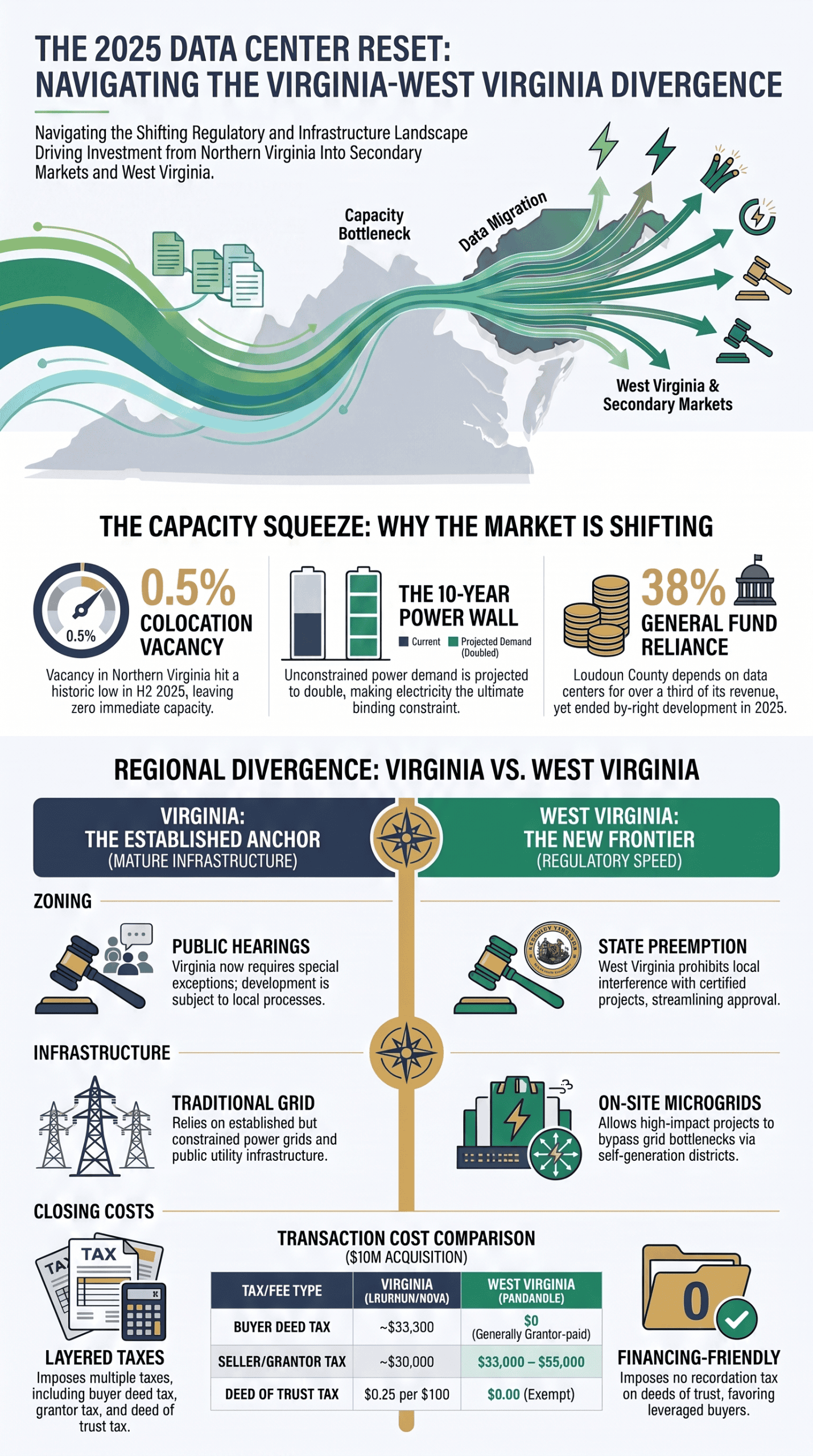
You cannot talk about roles without first talking about the map, because 2025 redrew it. On March 18, 2025, the Loudoun County Board of Supervisors voted seven to two to end by-right data center development in the districts where it had powered two decades of growth. New projects in those districts now need a special exception: staff review, public hearings before the Planning Commission and the Board, and a discretionary vote. A narrow grandfathering resolution protects applications accepted before February 12, 2025 that sit more than five hundred feet from homes and move forward without substantial modification, with an increase of more than five percent in square footage treated as substantial. I cover the full mechanics in my deep dive on data center zoning after Loudoun’s 2025 change.
The stakes behind that vote are not abstract. Data centers fund roughly 38 percent of Loudoun’s fiscal year 2026 revenue, about $1,200,000,000, and industry estimates put around 70 percent of the world’s internet traffic through Northern Virginia. The market is also nearly full: CBRE’s research shows colocation vacancy collapsing across three periods to a record low half of one percent. Meanwhile the Joint Legislative Audit and Review Commission’s December 2024 study projects Virginia’s data center energy demand roughly doubling within a decade under its unconstrained forecast, and new generation and transmission are not arriving on the same clock. Scarcity, discretion, and a strained grid now define the mature market.
Vacancy rate by reporting period, per CBRE research
Source: CBRE Research, 2025. A record low for the largest data center market in the world.
West Virginia read the same map and went the other way. House Bill 2014, the Power Generation and Consumption Act, was signed in April 2025 and took effect on July 11, 2025. It bars counties and municipalities from enacting or enforcing rules that would prohibit or hinder a certified microgrid district or a certified High Impact Data Center project, and it defines a High Impact Data Center as a facility with an aggregate critical IT load of 90 megawatts or more placed into service on or after July 1, 2025. Certification runs through the state: a petition is due within 30 days of the project knowing it meets the definition, and the secretary confirms certification within 14 days of a complete filing. Property for certified projects is valued through the state Board of Public Works and distributed by a statutory formula, with half the collections going to a personal income tax reduction fund and thirty percent to the host county.
The law also opens a power path Virginia does not offer the same way: a certified microgrid may serve data centers behind the meter when more than seventy percent of its generation is consumed by data centers, exempt from Public Service Commission jurisdiction over rates and interconnection inside a certified district. Two projects had been certified as of mid 2026, a roughly $4,000,000,000 campus in Berkeley County and a Google campus in Putnam County, and the state’s own legislative findings recite that Loudoun County holds the highest concentration of data centers in the world, which tells you exactly whose overflow the statute was written to catch. The candor cuts both ways: reporting in the Charleston Gazette-Mail and West Virginia MetroNews documents live certification disputes and organized community opposition in several counties, so the friction has moved rather than vanished.
Side by side: two states, one table, and the tradeoffs
A short walk through the Virginia and West Virginia tradeoffs this section lays out: entitlement, power, fiber, and who pays at closing.
Before the role chapters, here is the whole divergence in one view. None of these rows makes one state better. They make the states different, and which differences matter depends on the seat you hold, which is why the six chapters that follow keep coming back to this table.
| The question | Virginia | West Virginia |
|---|---|---|
| Entitlement path | Special exception with public hearings and a discretionary vote in Loudoun’s changed districts; other Northern Virginia localities tightening on their own schedules | State certification for qualifying projects; localities barred from hindering certified districts under HB 2014 |
| Power path | Utility grid, interconnection queues, and new transmission on a strained system | Certified microgrid option: onsite generation serving data centers behind the meter, PSC-exempt inside certified districts |
| Fiber depth | The densest fiber market on earth around Ashburn, with rights that still must reach your parcel | Thin outside a few corridors, which makes the recorded route rights more decisive, not less |
| Who pays at closing | Buyer carries the recordation stack and the deed of trust tax; seller pays the grantor’s tax plus regional fees in Northern Virginia | Seller carries the transfer excise by default; buyer records the deed and the deed of trust without a value-based tax |
| Property tax model | Local county assessment | Certified High Impact projects valued by the state Board of Public Works under a statutory distribution formula |
| Who conducts the closing | Licensed settlement agents, including attorney-led firms like mine | The West Virginia State Bar’s unauthorized practice opinion treats title examination and the closing as attorney work |
Sources: Loudoun County ZOAM-2024-0001 and CPAM-2024-0001 (adopted March 18, 2025); West Virginia HB 2014 (2025); Code of Virginia Title 58.1, Chapter 8; West Virginia Code 11-22-2; West Virginia State Bar Committee Opinion No. 2003-01.
+ The deepest power and fiber ecosystem in the world, with the comparables, lenders, and liquidity that come with it
+ Mature land records and survey infrastructure, so a careful title team can see a long way into a parcel’s history
+ Enormous tenant demand against a half-percent vacancy market, which protects exit value for a clean asset
+ A settled, familiar closing framework for institutional counsel and lenders
– Entitlement is now discretionary in the core: hearings, conditions, and calendar risk after the March 2025 change
– The grid is the binding constraint, and new transmission does not arrive on a deal timeline
– The buyer carries the tax stack, including the deed of trust tax on financed deals
– Land leaving use-value assessment triggers roll-back taxes reaching back five years plus the current year, with interest, under Virginia Code 58.1-3237
+ A state certification path that localities cannot hinder for qualifying projects, which converts entitlement risk into a defined process
+ The microgrid option moves the power question from a utility queue to assets and land rights you can actually buy
+ No value-based tax on recording the deed or the deed of trust, which favors debt-financed buyers at closing
+ A lower entry basis than the Northern Virginia core, with the state actively recruiting the overflow
– Fiber is thin outside a few corridors, so a missing recorded segment has no redundancy behind it
– Coal, oil, and gas estates severed generations ago can sit under the surface with rights that constrain the build
– Certification disputes and community opposition are live in several counties, so the process is defined but not frictionless
– Fewer comparables and a shallower institutional market on exit, at least for now
Owner-Operator: your uptime lives on this title
You are buying the building your own infrastructure will run in, which means your capital at risk is not just the purchase price. It is the operation. A stranded power feed, a fiber route that dead-ends, or an access gap does not show up on your balance sheet as a title problem. It shows up as downtime, a missed deployment, or a facility you cannot expand on the schedule your roadmap assumed. Your seat is the one where the gap between what the record grants and what the operation needs converts directly into operational loss.
So your diligence question is never whether the site looks served. It is whether the record supports the operation. The recorded power and transmission easements have to actually reach the pad, and a corridor across your buildable area can move the layout, which I walk through in the deep dive on power and transmission easements. The fiber has to be a recorded, durable right that transfers to you, not a conduit one parcel away, which is the subject of fiber and conduit rights. And the entrance your equipment convoys will use has to be a recorded right rather than a habit, which is where legal access and haul routes comes in.
The state question from your seat is a power-versus-connectivity trade. Virginia gives you the densest fiber and the deepest operational ecosystem on earth, against a strained grid and a discretionary entitlement path for new capacity. West Virginia gives you a statutory route to power through a certified microgrid, against thinner fiber where the recorded route is everything and against subsurface estates that may belong to someone else. Neither answer is wrong. What is wrong is assuming either one without reading the record first.
• Every recorded power, transmission, fiber, water, and access right, mapped against the ALTA survey and your engineers’ layout
• The expansion parcels tied into the legal description, so the room you are counting on is inside the deed
• Restrictions and covenants read against the operation you actually plan to run
• A closing sequenced to your possession date, with escalation to you before any date slips
• Plain-language flags, so your operations team hears the problem the day we find it
Operational confidence: you know whether the recorded rights support the operation before closing, not the first time a neighbor closes a gate or a feed comes up short.
Investor or Developer: the record prices your pro forma
Your risk is different in kind. You are not buying an operation. You are buying the right to create one, and every line of your pro forma rests on rights the county recorded long before you arrived. A transmission easement across the pad changes the site plan. A proffer from a 2016 rezoning caps the density you underwrote. An outparcel missing from the legal description deletes a phase. The dirt rarely kills a development deal. The record does, and it does it quietly, which is why I tell developers the record prices the pro forma before the market ever gets a vote.
The 2025 reset made your seat the most calendar-sensitive one at the table. In Loudoun’s changed districts your path now runs through hearings and a discretionary vote, and the grandfathering line is precise: accepted before February 12, 2025, more than five hundred feet from homes, diligently pursued, no substantial modification. If you are buying a site with a pending application, its grandfathered status is a central deal term, and a change as small as a six percent bump in square footage can forfeit it. The full analysis lives in my Loudoun 2025 zoning deep dive, and the parcel mechanics behind phased campuses live in expansion parcels and legal descriptions.
Two Virginia-specific numbers belong in your model from day one. First, recorded proffers and conditions run with the land no matter what the seller remembers, so the ceiling on the property is whatever the record says it is. Second, if the land is leaving use-value assessment, Virginia Code 58.1-3237 triggers roll-back taxes for the five most recent complete tax years plus the current year, with interest, and who pays that is a contract term you want settled at the letter of intent, not discovered at the table. In West Virginia the calculus flips: certification converts entitlement risk into a defined thirty-day-and-fourteen-day process, but your diligence burden shifts to generation footprints, fuel supply rights, thin fiber, and whatever sits severed beneath the surface.
• A title order opened at the letter of intent, so the commitment, survey, and easement review run ahead of your diligence clock
• Every recorded proffer, condition, covenant, and easement surfaced and dated, with conflicts against your plan flagged for land use counsel
• The legal description reconciled to the survey, the tax parcels, and the contract, phase by phase
• Roll-back tax exposure identified early so the allocation is negotiated, not inherited
• Curative work started immediately on anything that threatens the capital timeline, including 1031 exchange deadlines
Better risk visibility: the recorded rights and restrictions that can move the build, the lease-up, and the exit are on the table while the price can still reflect them.
Investment Firm: institutional control at closing speed
A stabilized data center trades at a scale where the closing itself becomes an operational risk. You have an investment committee, a fund structure with layered entities, lender requirements, estoppels and subordination agreements, and reporting obligations, all stacked on top of the title work. Your exposure is rarely one dramatic defect. It is process failure: an authority document missing at signing, an exception nobody owned, an escrow condition that was oral instead of written, a wire that moved on an emailed change. At your volume, the American Land Title Association’s data is simply your base rate: the industry clears more than $600,000,000,000 in risk each year, and nearly sixty percent of transactions need three to five title issues resolved before closing.
What your seat needs is not heroics. It is a repeatable machine. Entity and fund authority verified against formation documents and resolutions before closing week. Escrow held under written instructions and disbursed only when stated conditions are met. Estoppel and subordination paper circulated early enough to survive a surprising answer. Exceptions and curative items tracked on one list with an owner and a status, visible to your counsel and your lender. And on assets that were recently built or expanded, which is most of them, lien exposure handled the way I describe in the deep dive on mechanic’s liens from construction: investigated, papered with waivers and affidavits, and escrowed where real exposure remains.
The two-state angle for a fund is mostly about repeatability. Virginia gives you a familiar institutional framework and deep comparables. West Virginia adds a certification layer, a Board of Public Works tax model your underwriting has to reflect, and a closing that the state bar’s guidance places in attorney hands, which means West Virginia counsel belongs in the working group from day one rather than week eight. My firm is built for exactly that handoff, because the file is attorney-led on our side already.
• One repeatable closing process across acquisitions: same controls, same documentation, same escalation path
• Entity, fund, and signing authority collected and verified at the contract stage, matched to your approval chain
• Large escrow under written instructions, with wires verified by phone against known contacts and no changes accepted by email
• Estoppel, subordination, and lender requirement tracking raised at the front of the file
• A single open-items list for exceptions and curative work that your counsel and lender can see
Controlled execution: title, escrow, approval, and reporting run the same way on the tenth file as the first, at the scale these deals actually close.
Corporate and M&A: the facility must track the platform
When data centers move inside a company or platform acquisition, the real estate is one workstream inside a much larger machine, and your risk is sequencing. The corporate closing has a date. The facilities have deeds, assignments, lender consents, landlord consents on leased sites, and change-of-control provisions scattered through the operational contracts. If the real estate workstream slips, the platform closing slips with it, and at platform scale the cost of a slipped date is measured in ways no title premium ever is.
Structure decides the paperwork. An asset deal moves the facilities by deed, which means every legal description, every recorded right, and every transfer tax gets touched. An equity deal moves the entities that own the facilities, which quiets the transfer taxes but not the diligence: title, liens, and authority still have to be confirmed, and the change of control can itself trigger consent requirements buried in fiber agreements, colocation contracts, and financing documents. The assignability problem I describe in the fiber and conduit rights deep dive is exactly the kind of provision that treats your acquisition as an event, and the schedule mechanics of multi-parcel campuses come straight out of expansion parcels and legal descriptions.
Across the two states, your issue is inventory discipline. A platform rarely sits in one jurisdiction, so the owned-and-leased schedule has to be right, the West Virginia facilities have to route through West Virginia counsel for the settlement itself, and the debt releases have to land in the same hour as the corporate close. That choreography is coordination work, and it is precisely the work a title and escrow team should own so deal counsel does not have to.
• The owned and leased facility schedules reconciled against the record, parcel by parcel and state by state
• Asset-versus-equity transfer mechanics coordinated with deal counsel, including what the structure means for taxes and recording
• Lender payoffs, releases, and third-party consents tracked to the corporate closing date, with dependencies flagged early
• Change-of-control triggers in recorded and referenced agreements identified for counsel before they identify themselves
• Closing and post-closing documentation delivered the way an integration team actually needs it
Transaction alignment: the facility transfers keep pace with the platform closing instead of becoming the reason it moves.
Executive and Finance: the short list that moves money
You do not need the diligence stack. You need the short list: what is actually unresolved, what the funding requirement is, which dates move money, and whether the closing is honestly ready. Everything else is detail that belongs to the people you hired to handle it. The failure mode of your seat is not missing information. It is drowning in it, while the two or three items that genuinely move capital arrive late, softened, or not at all.
Two of those items deserve to be named, because they are the ones that reach your desk after it is too late. The first is wire fraud. Industry survey data reports that roughly one in three real estate transactions faces an attempted wire fraud, with average losses in the range of $150,000 to $200,000 and commercial deals running higher, and at data center scale a single redirected wire is a company-altering event. The second is the lien that arrives after closing: in both Virginia and West Virginia, a mechanic’s lien can relate back to when the work began, so a clean search on closing day is a starting point rather than a verdict, as I explain in the mechanic’s lien deep dive. Both risks are managed with process, and the process is visible in the closing-week math below: verified instructions, written conditions, waivers and escrow where exposure remains.
From your chair the state question is mostly financial architecture. Virginia’s stack puts the recordation and financing taxes on your side of the ledger, and the deed of trust tax alone is real money on a financed deal. West Virginia’s default shifts the transfer excise to the seller and records your financing without a value-based tax, which is why leveraged buyers keep asking me about the Eastern Panhandle. The numbers are in the next section, sourced line by line.
• A short list on demand: unresolved title matters, the funding requirement, and the dates that move money
• Fraud-protected funding: wire instructions established at file opening, verified by phone with known contacts, never changed by email
• Disbursement only when written closing conditions are met and documented
• The final cash requirement reconciled early, so the number on closing day is the number you approved
• Named principals you can call, and escalation to you before a deadline slips rather than after
Decision-ready information: material risks, costs, deadlines, and funding requirements reach you in plain language, without the document dump.
Legal and Deal Team: one tracked list, no duplicated work
You are running the transaction, and the last thing you need is a settlement shop that either duplicates your work or waits for instructions. What you need from title and escrow is a lane run completely: the commitment, the ALTA survey and Table A scope, the easement and exception review, the curative items, the escrow instructions, the funding, the recording, and the policy, all on one open-items list that you, the lender, and the other side can see. My team runs that lane with attorneys, which matters on data center files because the judgment calls inside it are legal ones: whether an easement chain actually reaches the pad, whether a proffer conflicts with the intended use, whether an authority document supports the signature block it needs to.
The technical spine of the lane is the survey read against the record. The recorded corridors from the power and transmission review and the access rights from the access and haul route review only mean something when they sit on the same drawing as the commitment’s exceptions, which is why I coordinate the Table A scope with you and the lender at the start rather than reconciling three documents in closing week. The curative pile gets the same discipline: every requirement, exception, and release has an owner and a status before closing week begins, and the full framework, if you want it for an associate, is on my page explaining what a title and escrow company does.
Jurisdictionally, plan for the two states differently. Virginia is a settlement-agent state where an attorney-led file is a choice, and on these assets I would argue a necessary one. West Virginia is different in kind: the State Bar’s unauthorized practice opinion, Committee Opinion No. 2003-01, treats title examination and the conduct of the closing as the practice of law, so a licensed West Virginia attorney belongs on the closing team from day one, and any High Impact certification work runs alongside it. Wherever the parcels sit, deal counsel keeps strategy and negotiation. We keep the record, the money, and the recording, and the seam between us stays visible on the list.
• Title commitment, exception analysis, and curative items on a shared open-items list with owners and status
• ALTA survey ordering and Table A scope set with you and the lender, then reconciled against the commitment
• Utility, transmission, fiber, and access easements reviewed and mapped, with legal-judgment flags rather than raw exceptions
• Entity authority, resolutions, and signature blocks verified against the structure chart
• Escrow instructions, funding, recording in every county on the schedule, and final policy issuance
Cleaner coordination: the settlement lane runs itself, the list stays current, and your team spends its hours on the deal instead of the machinery.
The risk map: what finds each seat first
Every risk in this article eventually touches every seat, but each one has a natural first victim, and knowing yours tells you where to spend diligence attention. Here is the map I use, with the deep dive for each risk linked in the last column.
| Where you sit | The risk that finds you first | Where it hides | The deep dive |
|---|---|---|---|
| Owner-Operator | A recorded right that does not support the operation: power, fiber, or access falling short of the pad | Easement chains, corridor widths, and route gaps visible only when the record meets the survey | Power and transmission easements |
| Investor or Developer | A recorded proffer or condition that caps the build you underwrote | Prior rezonings and special exceptions recorded against the land, sometimes decades old | Zoning after Loudoun’s 2025 change |
| Investment Firm | A missing parcel or authority defect surfacing in front of the committee | Contract exhibits, legal descriptions, and entity resolutions that were never reconciled | Expansion parcels and legal descriptions |
| Corporate and M&A | A consent or change-of-control trigger that stalls the platform date | Fiber agreements, financing documents, and operational contracts referenced by the record | Fiber and conduit rights |
| Executive and Finance | A redirected wire, or a lien filed after closing with an earlier priority date | Email-borne instruction changes, and lien windows still open from the seller’s construction | Mechanic’s liens from construction |
| Legal and Deal Team | An access or survey gap discovered in closing week instead of diligence | The seam between the recorded easements, the ALTA survey, and the commitment’s exceptions | Legal access and haul routes |
Every risk here is curable when it surfaces at the letter of intent. Most are expensive when it surfaces after the wire.
The closing-week math on a $10,000,000 deal
Roles decide who cares about which line, so here is the whole picture on a $10,000,000 purchase, sourced line by line. In Virginia, the buyer pays the state recordation tax of $0.25 per $100 under 58.1-801 plus the local third under 58.1-814, about $33,300 together. A financed buyer also pays the deed of trust recordation tax under 58.1-803, $0.25 per $100 on the first $10,000,000 of debt, which is $25,000 of state tax alone before the local third is added. The seller pays the grantor’s tax of $0.50 per $500 under 58.1-802, and in the Northern Virginia jurisdictions adds the WMATA Capital Fee under 58.1-802.3 and the Regional Congestion Relief Fee under 58.1-802.4, bringing the seller’s side to $30,000 on this deal size.
In West Virginia, the architecture inverts. The transfer excise under West Virginia Code 11-22-2 falls on the seller by default and runs from $33,000 at the floor to $55,000 at the maximum county rate on a $10,000,000 conveyance. The buyer records the deed and the deed of trust without a value-based tax, paying flat recording fees instead, which is why debt-financed buyers notice West Virginia immediately: the two Virginia lines that hit the buyer hardest simply do not exist. Allocation is negotiable in both states, so treat the defaults as the starting position for the contract, not the ending one.
Statutory defaults by state and side of the table; every line negotiable by contract
Sources: Code of Virginia 58.1-801, 58.1-802, 58.1-802.3, 58.1-802.4, 58.1-803, 58.1-814; West Virginia Code 11-22-2. West Virginia buyer pays flat recording fees; the excise falls on the seller by default. West Virginia bar shown at the maximum county rate.
Two more lines belong in the model even though they are not closing-table taxes. In Virginia, land converting out of use-value assessment carries roll-back taxes under 58.1-3237 for the five most recent complete tax years plus the current year, with interest, which on raw acreage can be a six-figure number that deserves a named payer in the letter of intent. And in West Virginia, a certified High Impact project’s property is valued through the state Board of Public Works under the HB 2014 formula rather than by the county, which changes the operating tax model your underwriting should be built on.
Why a team of attorneys, and why independence matters
Here is the honest version of the pitch. Most of what a title company does on a simple deal is process, and process does not need a law degree. A data center acquisition is not a simple deal. The questions that decide it are legal questions: whether an easement chain actually reaches the pad, whether a 2016 proffer conflicts with a 2026 building, whether a description conveys the phase you priced, whether a resolution supports the signature it needs to, whether a lien window is still open and what closes it. A checklist can record those questions. It takes legal judgment to answer them, and at Prime Title & Escrow the people answering are attorneys, led by me and by my partner Adam L. Engel, Esq., working from Leesburg in Loudoun County, in the middle of the market this article describes.
Independence is the other half. We take no referral fees and join no affiliated arrangements, so nobody upstream of your file is paid for our answer to be yes. That matters most exactly when the answer should be no, or not yet, or not at this price. It is also why I am precise about our lane: we do not size your power, run your interconnection queue, design your fiber, argue your special exception, or assess environmental condition. Your engineers, utility, land use counsel, and consultants own those, and we coordinate with them rather than pretend at them. On West Virginia parcels, where the State Bar’s guidance places the closing itself in attorney hands, that coordination includes West Virginia counsel from the first week.
And because this article will be read by people deciding whether to trust it, every load-bearing figure in it is named to a source in the list below: the Loudoun ordinance record, the enrolled text of HB 2014 and the West Virginia Code, the Virginia and West Virginia tax statutes, JLARC, CBRE, and the land title industry’s own data. Where a number could not be sourced, it is not in the article. That is the same discipline we apply to your file, and it is the entire reason a closing run by attorneys is worth having: not because the letters after the name are decorative, but because the record decides the deal, and reading the record is what we do.
Questions I hear about roles and risk
I wear more than one hat on this deal. Which seat should I read?
Read the seat where the loss would land. A founder who is both the operator and the money should read Owner-Operator first, because downtime usually costs more than a tax line, then Executive and Finance for the funding controls. A developer raising a fund should read Investor or Developer for the record risk and Investment Firm for the process controls. The risks do not change with your title; the order you should worry about them does.
Does the Virginia versus West Virginia choice really change by role?
Yes, because the states trade different risks. A debt-financed buyer feels West Virginia’s missing deed of trust tax immediately, an operator feels Virginia’s fiber depth and West Virginia’s thin routes, a developer feels Loudoun’s discretionary hearings against West Virginia’s defined certification clock, and counsel plans for the West Virginia State Bar’s attorney-closing guidance. Same map, different weight on every road, which is why the comparison table and the closing math in this article are organized by seat.
Why does a data center closing need a team of attorneys instead of a standard title agency?
Because the questions that decide these files are legal judgments, not lookups: whether an easement chain reaches the pad, whether a recorded proffer caps the build, whether a description conveys the phase you priced, whether an authority document supports the signature. A standard agency can record those questions; attorneys can answer them, and in West Virginia the State Bar’s unauthorized practice opinion treats the closing itself as attorney work. Independence completes it: with no referral fees, our only loyalty is the file.
Send me the site, the seat you hold, and the target date, and my team will read the recorded rights from your side of the table, flag what moves money and dates, and map the closing from letter of intent to recording.
Get Your Free Quoteor call (703) 552-4155This article is the role-based companion to my full data center buyer’s guide to Virginia and West Virginia and the data center title and settlement service. Each of the six recurring challenges also has its own deep dive:
Power and transmission easements • Fiber and conduit rights • Legal access and haul routes • Zoning after Loudoun’s 2025 change • Expansion parcels and legal descriptions • Mechanic’s liens from construction
Sources
Every legal framework and figure named here is drawn from the sources below, current as of the dates shown. Where a source did not provide a figure, I have left it out rather than estimate.
Loudoun County, Virginia. Data Center Standards and Locations (ZOAM-2024-0001, CPAM-2024-0001, adopted March 18, 2025). loudoun.gov
West Virginia House Bill 2014 (2025 Regular Session), the Power Generation and Consumption Act, enrolled text, signed April 2025 and effective July 11, 2025. wvlegislature.gov
West Virginia Code, § 5B-2-21a, High Impact Data Center Program, and associated legislative findings. code.wvlegislature.gov
Joint Legislative Audit and Review Commission of Virginia. Data Centers in Virginia (December 2024).
CBRE Research, North America data center market reporting, 2025 (Northern Virginia colocation vacancy).
Code of Virginia, Title 58.1, Chapter 8, State Recordation Tax, §§ 58.1-801 through 58.1-814, including § 58.1-802.3, § 58.1-802.4, and § 58.1-803. law.lis.virginia.gov
Code of Virginia, § 58.1-3237, roll-back taxes on change from use-value assessment. law.lis.virginia.gov
West Virginia Code, § 11-22-2, Excise tax on privilege of transferring real property. code.wvlegislature.gov
West Virginia State Bar, Committee Opinion No. 2003-01 (unauthorized practice of law; real estate settlement services). wvbar.org
American Land Title Association, industry data cited in text (risk cleared annually; share of transactions requiring title issue resolution; wire fraud attempt and loss figures, with Stewart). alta.org
DataCenterMap.com facility counts for Virginia and West Virginia, as reported by the Parkersburg News and Sentinel (November 2025). newsandsentinel.com
Charleston Gazette-Mail and West Virginia MetroNews reporting on HB 2014 rulemaking, certified projects, and certification disputes (2025 to 2026).
Industry estimates for Northern Virginia internet traffic share (Mordor Intelligence) and Loudoun County data center footprint and fiscal contribution (industry reporting including City Journal), as cited on my data center service page.
This article provides general educational information for Virginia and West Virginia and is not legal, engineering, land use, tax, or regulatory advice for any specific transaction. Every acquisition requires review of its own property, documents, parties, intended use, and title-insurance terms. Legal frameworks and figures are attributed to their sources and reflect the dates those sources describe, and they continue to change. Please confirm anything you intend to rely on, and reach out to me directly with questions about your own deal.