
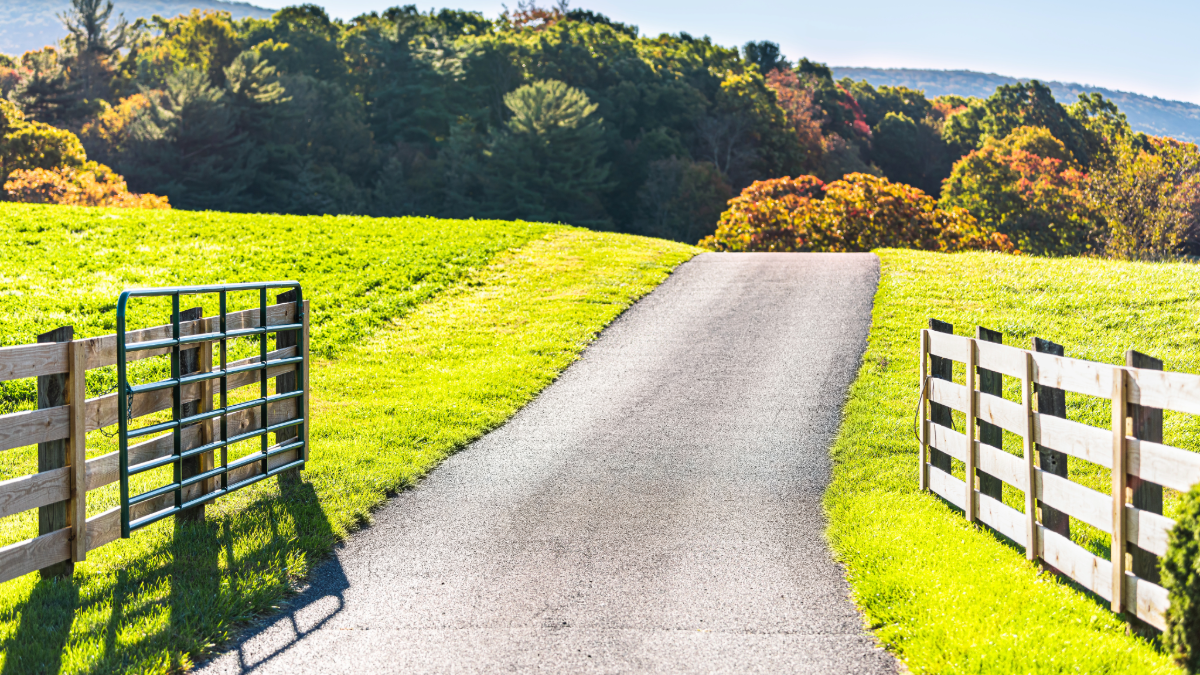
Two houses, one driveway, no document. Or a subdivision on a gravel road the county has never accepted. Shared and private access is common across rural and older Virginia, and it is one of the few title issues that can stop a loan outright. Here is what a road maintenance agreement does and why your lender may insist on one.
Who owns the road you drive on
Every road is either public, meaning a government body accepted it and maintains it, or private, meaning somebody else does. Private is not unusual and is not a defect. What matters is whether your right to use it is recorded and whether responsibility for maintaining it is written down.
A shared driveway is the smallest version of the same question. Two neighbors use one strip of pavement. It sits on one parcel, or straddles the line, or nobody is quite sure. Everyone has gotten along for twenty years. Then it needs resurfacing, or one house sells, and the absence of a document becomes the whole conversation.
Getting along is not a maintenance agreement
The arrangement works until it does not. What breaks it is usually money, a new neighbor with different expectations, or a sale where the buyer’s lender asks for something in writing that nobody ever created.
Why lenders care
Several loan programs, particularly government backed ones, want assurance that a property on a private road has both recorded legal access and a durable arrangement for keeping the road usable. A lender is underwriting a thirty year loan on a house that has to remain reachable by an ambulance and a fire truck for the whole term.
Requirements differ by program and change over time, so the specific one that applies to your buyer is a question for their lender rather than for us. What is consistent is the shape of it: recorded access plus a recorded maintenance obligation. When one is missing, the loan stalls, and it becomes a closing delay that nobody anticipated.
What a road maintenance agreement contains
A workable agreement identifies the road by a legal description or a recorded plat reference, names the parcels entitled to use it, allocates the cost of maintenance among them by some stated formula, states what standard of maintenance is required, provides a way to make decisions and a remedy when someone refuses to pay, and says explicitly that it binds future owners rather than only the people signing today.
That last clause is the one most often missing from homemade agreements. A document signed by two neighbors that does not run with the land binds those two neighbors and nobody who buys from them.
An unrecorded agreement may not bind the next owner
A handshake, an email chain, or even a signed letter kept in a drawer is unlikely to bind a purchaser who never saw it. The agreement has to be recorded in the land records for the obligation to travel with the parcels.
Creating one when it does not exist
This is the difficult part, because it requires the cooperation of every owner along the road. A single holdout can prevent an agreement that everyone else wants, and that owner may have no incentive to sign, particularly if they are not selling.
It goes better when it starts early. A seller who addresses it before listing is negotiating with neighbors calmly. A seller who discovers it two weeks before settlement is asking neighbors for a favor under a deadline, and neighbors sometimes notice the bargaining position that gives them. If you own on a private road and expect to sell in the next few years, this is worth doing now.
Where the survey earns its cost
On shared access, the survey answers questions the deed cannot. Where does the driveway physically sit relative to the property line. Does it match the recorded easement, if there is one. Has the travelled way drifted over the years into a position nobody has a right to. Encroachment questions like these are covered in boundary disputes and encroachments.
How we help
We identify from the record whether the road is public or private, locate any recorded easement or maintenance agreement, tell you and your lender exactly what exists, and flag early where something is missing so there is time to fix it. Where an agreement has to be created or a recorded easement corrected, we prepare and record the instrument. The wider access question is in legal access and landlocked property.
Buying on a private road or shared driveway?
Send us the property and we will tell you what the record shows about access and maintenance before your lender asks. Independent, attorney-led title and escrow across Virginia and West Virginia.
Get Your Free Quoteor call (703) 552-4155
Common questions
What is a road maintenance agreement?
A recorded document among the owners served by a private road, allocating who maintains it, to what standard, and how the cost is divided. It should state that it binds future owners so the obligation travels with the parcels.
Does my lender require one?
Several loan programs, particularly government backed ones, expect recorded legal access and a durable maintenance arrangement for a property on a private road. Requirements vary by program and change, so confirm with the lender early.
Is a handshake agreement with my neighbor enough?
Probably not for a lender, and probably not to bind whoever buys the neighboring house. To travel with the parcels, the agreement generally needs to be recorded in the land records.
Who pays to fix a shared driveway?
Whatever a recorded agreement says. Without one, it becomes a negotiation, and the absence of a stated formula is exactly what turns a resurfacing bill into a dispute.
What if one neighbor refuses to sign?
That is the hard case, since an agreement generally needs everyone the road serves. A holdout who is not selling may have no incentive to participate, which is why this work goes far better started well before a listing.
Can a private road become public?
Only if the responsible government body accepts it, which typically requires the road to meet standards it may not currently meet. It is not something that happens because residents want it.
This article is general information about private roads, shared driveways, and maintenance agreements in Virginia and West Virginia. It is not legal or lending advice. Loan program requirements vary and change, so confirm current requirements with your lender.